About Amphiprion polymnus (Linnaeus, 1758)
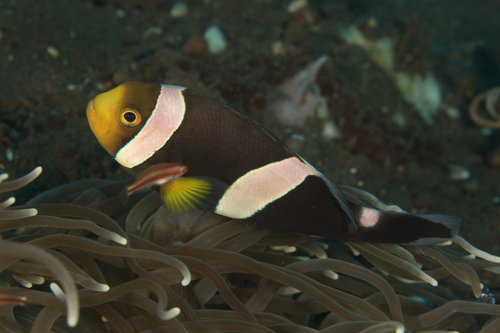
Amphiprion polymnus is a small fish that reaches a maximum length of 13 centimeters (5.1 inches). Unlike other anemonefish groups where the female is always larger than the male, males of this species are almost equal in size to females. It has a stocky, oval-shaped body that is laterally compressed with a rounded profile. Its body color ranges from dark brown to yellow-orange, and the species has two or three white bars. A thick white bar runs across the head just behind the eyes. A large, incomplete white saddle shape or slanted white bar across the middle of the body is the feature that gives this species its common name, Saddleback anemonefish. In some variants, most often specimens that originally associate with the anemone Heteractis crispa, the saddle shape may extend onto the dorsal fin, and a third white bar or margin runs across the caudal peduncle, as pictured in the taxobox. The outer edges of the caudal and anal fins are outlined with a white line. Across all color variations, the snout and pectoral fin are orange-yellow to brownish-orange. A. polymnus is distributed across the central Indo-Pacific region known as the Coral Triangle, ranging from the Philippines to Indonesia and New Guinea. It is also found in northern Australia, Melanesia, and the Ryukyu Islands of southern Japan. Adult fish live in silty lagoons and harbour areas, at depths between 2 and 30 metres (6.6 to 98.4 ft).