About Amphiprion frenatus Brevoort, 1856
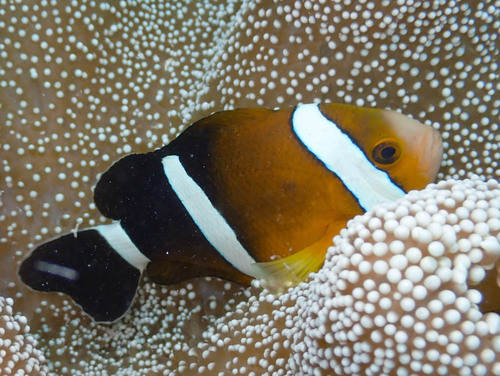
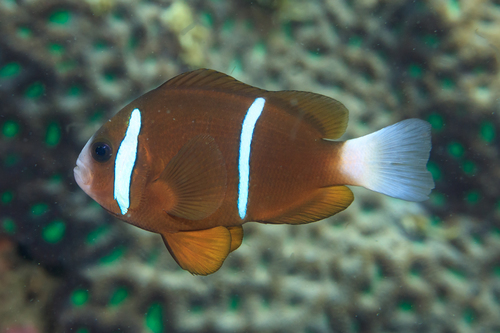
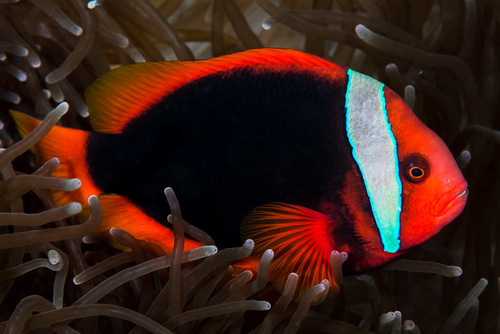
As an anemonefish (clownfish), Amphiprion frenatus Brevoort, 1856 forms a symbiotic mutualism with sea anemones in the wild. Clownfish are not harmed by their host anemone's stinging tentacles: the anemone provides clownfish with protection from predators and food scraps from its meals, plus occasional dead anemone tentacles. In exchange, clownfish protect their host anemone from predators and parasites. All clownfish are small, measuring between 10 and 18 centimetres (3.9 to 7.1 inches) long. Their overall body color varies by species, ranging from yellow, orange, and reddish to blackish, and many clownfish have white bars or patches. Color variations can occur within a single species, most often linked to geographic distribution, but also to sex, age, and host anemone species. Clownfish generally live in warm waters of the Indian Ocean, Pacific Ocean, and Red Sea, in sheltered reefs or shallow lagoons. Clownfish groups follow a strict dominance hierarchy, with the largest and most aggressive individual holding the top position as a female. Only one breeding male and one breeding female in a group reproduce via external fertilization. Clownfish are sequential hermaphrodites: all individuals develop as males first, and mature into females later. Adult Amphiprion frenatus are bright orange-red, with a white vertical head bar just behind the eyes that connects across the top of the head and has a distinct black outline. Female individuals are mainly blackish along their sides. Males are noticeably smaller than females and solid red overall. Juvenile Amphiprion frenatus are darker red, with two or three white bars. This species has 9 to 10 dorsal spines, 2 anal spines, 16 to 18 soft dorsal rays, and 13 to 15 soft anal rays, and reaches a maximum total length of 14 cm (5+1⁄2 in). Marine velvet disease (amyloodiniosis), caused by the dinoflagellate Amyloodinium ocellatum, is one of the most serious ectoparasitic diseases affecting warm-water marine fish. The tomato clownfish (Amphiprion frenatus) has strong, long-lasting immunity to this parasite. This immunity develops after multiple non-lethal infections and the production of specific antibodies. The immunoglobulin antibody produced has a 70 kD heavy chain and 32 kD light chains, with an estimated total molecular weight of 816 kD. Amphiprion frenatus is distributed from the Ryukyu Islands of southern Japan south through the South China Sea and surrounding areas, including Malaysia and Indonesia. Some sources note this species only associates with the bubble-tip anemone Entacmaea quadricolor, while other authorities record it also associating with the sebae anemone Heteractis crispa.