About Amphiprion clarkii (Bennett, 1830)
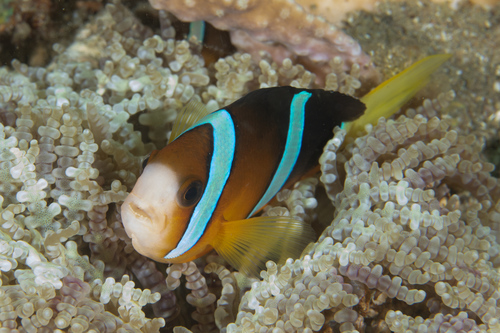
Clark's anemonefish, whose scientific name is Amphiprion clarkii (Bennett, 1830), is a type of anemonefish, also called clownfish. In the wild, all anemonefish form symbiotic mutualisms with sea anemones. Anemonefish are not affected by the stinging tentacles of their host anemone: the sea anemone protects the clownfish from predators, and provides food from scraps left after the anemone's meals and occasional dead anemone tentacles. In return, the clownfish defends the host anemone from its predators and parasites. In a stable environment with little change to water temperature, no increased predation, and no habitat degradation, anemonefish have a lifespan of around 10 to 11 years, per Lakshmi Sawitri. Clownfish are small fish, measuring 10–18 centimetres (3.9–7.1 in) long. Their overall color varies by species: they can be yellow, orange, reddish, or blackish, and many species have white bars or patches. Within a single species, color can vary, most commonly based on distribution, but also based on sex, age, and host anemone. Clownfish live in the warmer waters of the Indian Ocean, Pacific Ocean, and Red Sea, in sheltered reefs or shallow lagoons. Groups of clownfish have a strict dominance hierarchy, with the largest and most aggressive individual, a female, at the top. Only one male and one female clownfish in a group reproduce, via external fertilization. Clownfish are sequential hermaphrodites: they develop as males first, and become females when they mature. They are not aggressive. Observations of eight breeding pairs on a coral reef off the coast of the Philippines found this species prefers to breed in colder months, with a peak breeding season from November through May. Egg production increases leading up to the new moon, and decreases after the full moon. This seasonal spawning pattern is similar to that of other temperate-region clownfish species. Clark's anemonefish is small: males grow up to 10 cm (4 in), while females grow up to 15 cm (5+7⁄8 in). It has a stocky build, is laterally compressed, and has an oval to rounded body shape. It is brightly colored with vivid black, white, and yellow stripes, and its exact pattern varies considerably across different regions. Typically, it is black on its dorsal side and orange-yellow on its ventral side, and black areas grow wider as the fish ages. It has two vertical white bands: one behind the eye and one above the anus, and its caudal peduncle is white. Its snout is orange or pinkish. Its dorsal and caudal fins are orange-yellow, and the caudal fin is generally lighter in color than the rest of the body, sometimes becoming whitish. Clark's anemonefish is the most widely distributed anemonefish species: it lives in tropical waters from the Indian Ocean to the Western Pacific. According to Billy Moore, these anemonefish most commonly live in reef biomes at depths of 1 to 60 meters, in areas that have host anemones.