About Amphiprion chrysopterus Cuvier, 1830
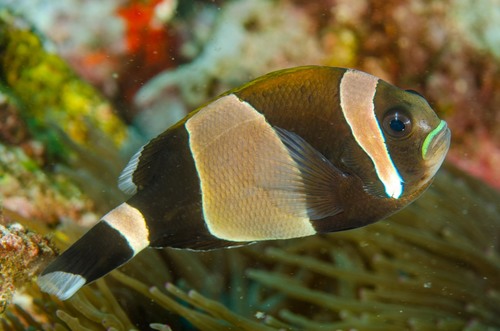
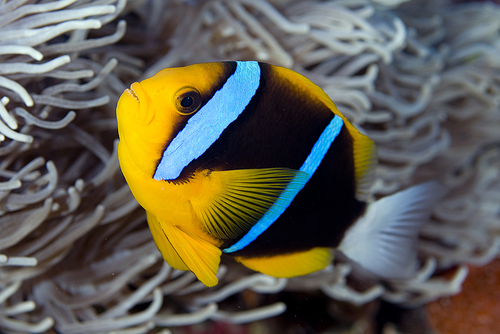
This species is the orange-fin anemonefish, Amphiprion chrysopterus, a type of anemonefish (clownfish). All wild anemonefish form symbiotic mutualisms with sea anemones. Anemonefish are unaffected by the stinging tentacles of their host anemone. The host sea anemone protects the anemonefish from predators, and provides the anemonefish with food from scraps left after the anemone’s meals and occasional dead anemone tentacles. In return, the anemonefish defends the host anemone from its predators and parasites. As a group, clownfish are small, reaching 10–18 cm (3.9–7.1 in) in total length. Depending on species, their overall body color is yellow, orange, reddish, or blackish, and many species have white bars or patches. Color variation can occur within a single species, most commonly by geographic distribution, but also by sex, age, and host anemone species. Clownfish live in warm waters of the Indian and Pacific Oceans and the Red Sea, in sheltered reefs or shallow lagoons. Clownfish groups have a strict dominance hierarchy. The largest and most aggressive individual in the group is female, and holds the top position in the hierarchy. Only one breeding male and one breeding female reproduce in any group, and they use external fertilization. Clownfish are sequential hermaphrodites: they all develop as males first, and mature into females later in life. Their diet consists mainly of planktonic copepods, algae, echiuroid worms, sipunculoid worms, and pelagic tunicates. Adult anemonefish generally live on reef passages and slopes. This species is oviparous, and forms distinct breeding pairs. Its eggs are demersal and adhere to the substrate. Males guard and aerate the eggs. For Amphiprion chrysopterus specifically, the body is short and deep, with a small head. The edges of the body are generally yellow, while the middle sides range from yellow-brown to dark brown. It has two white vertical stripes: the first sits behind the eye, and the second sits before the anus. Its fins are yellow to orange. Juvenile individuals are dull orange. The tail fin is generally white or yellow, with color differing by geographic origin: fish from the region around Fiji and Tonga have yellow tails, while fish from the Marshall Islands and Solomon Islands have white tails. This species has 10–11 total dorsal spines, and 15–17 total dorsal soft rays. It has two anal spines, and 13–14 anal soft rays. It can grow to a maximum length of 17 cm. Amphiprion chrysopterus is distributed in the Western Pacific, north of the Great Barrier Reef, ranging from the surface down to 20 m depth. Its range covers the Pacific Ocean between Queensland (Australia) and New Guinea, extending east to the Marshall Islands and Tuamotus Islands.