About Amphiprion akindynos Allen, 1972
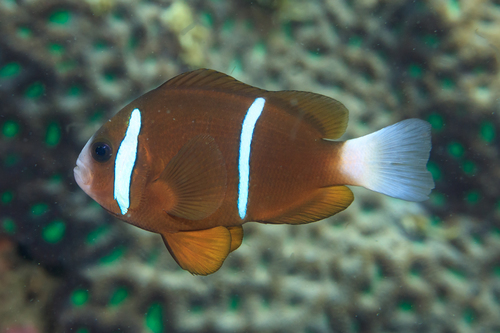
Adults of Amphiprion akindynos (Barrier Reef anemonefish) are orange-brown with two black-edged white bars encircling the body. The first bar sits behind the eyes on the head, and may be thin or broken. The second bar is located on the body below the dorsal fin. The caudal peduncle and caudal fin are white. Juveniles are normally brown with three white stripes, while sub-adults develop dull yellow colouring with two white stripes. This species has 10 to 11 dorsal spines and 2 anal spines, and reaches a maximum length of 12–13 cm (4.7–5.1 in). The Barrier Reef anemonefish inhabits lagoons and outer reefs in the Great Barrier Reef, Coral Sea, northern New South Wales, New Caledonia, the Loyalty Islands and Tonga. It was previously thought to be limited to depths of less than 25 m, but autonomous underwater vehicle surveys of mesophotic reefs at Viper Reef and Hydrographers Passage in the central Great Barrier Reef observed A. akindynos at depths between 50 and 65 m. A. akindynos is a nesting fish. A few days before mating, the dominant male increases aggression toward the female and starts clearing a nest site, usually on a rock near the host anemone. The rock is cleaned of algae, sometimes with assistance from the female. When spawning occurs, the female moves in a zig-zag pattern over the nest site, and the male follows to fertilize the deposited eggs. Between 100 and 1000 elliptical eggs 3 to 4 mm in length may be laid. The eggs attach to the nest site via a mass of short filaments. The male guards and aerates the eggs for 6 to 7 days until they hatch. After hatching, larvae are dispersed by currents and swimming. Larval mortality is high, and most surviving larvae settle on the original reef.