About Amphineurus hudsoni Edwards, 1923
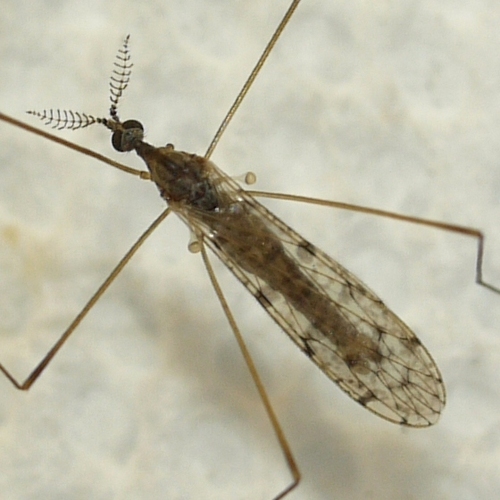
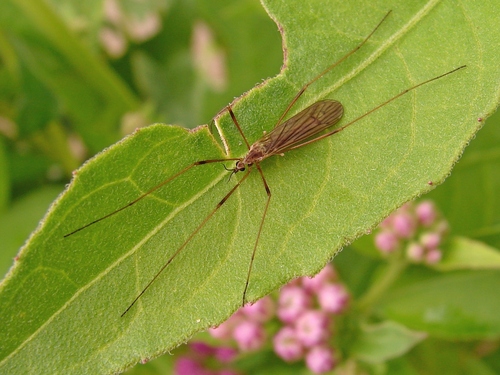
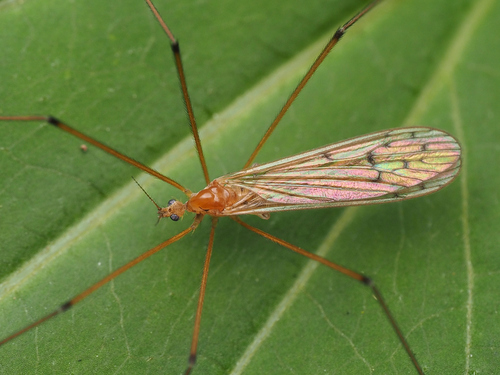
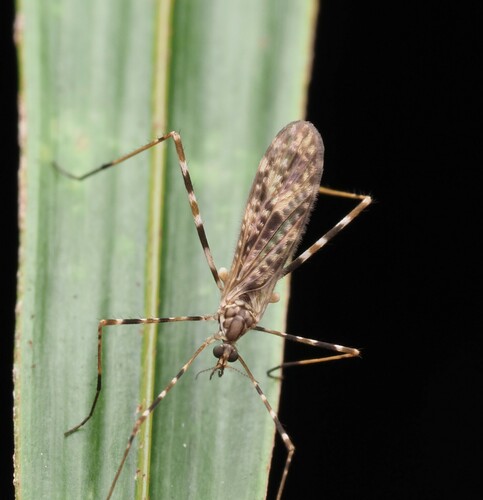
Edwards originally described the species Amphineurus hudsoni with the following characteristics. The head is dark grey, with some black hair. The proboscis and palpi are black. The scape and base of the flagellum of the antennae are ochreous, and the rest of the antennae are dark brown. Antennae have the same structure in both sexes. Flagellar joints are about three times as long as they are broad, slightly thicker in the middle, and have verticils that are only a little longer than the joints. On the thorax, the pronotum, a spot on the shoulders, and another spot in front of the wing-base are yellowish. The mesonotum is mostly covered by three brownish-grey stripes, which are narrowly separated at the front by dark-brown lines. The pleurae are pale grey with some dark-brown markings. The postnotum is brownish-grey, with a whitish spot on each side near its base. The abdomen is similar to that of A. bicinctus, but the male hypopygium of A. hudsoni only has two pairs of claspers. The third, middle pair is only present as minute rudiments. The upper pair of claspers is longer and more slender than in A. bicinctus, and smooth except at the tip, which is blunt and serrated. The ninth tergite has two large black pointed lobes. For the legs: the coxae are pale ochreous, dusted with grey; the trochanters are ochreous. The femora are ochreous-brown, with a blackish ring close to the base, plus two other rather broad blackish rings that are bordered on both edges with white. The tip of the femur is rather broadly ochreous-brown. The tibiae are brownish-ochreous, with a blackish ring near the base that is bordered with white. The tip of the tibia is broadly black, and is preceded by a narrow white ring. The tarsi are blackish. The wings are very similar to those of A. bicinctus, but have more numerous pale hairs, especially in the region of the cord. The halteres are ochreous. Body length is 5 mm, and wing length is 7 mm. This species is endemic to New Zealand, and occurs on both the New Zealand mainland and the Chatham Islands.