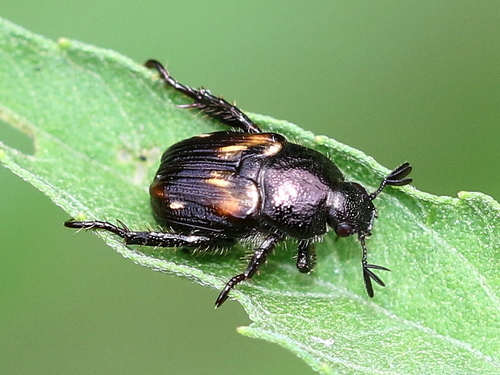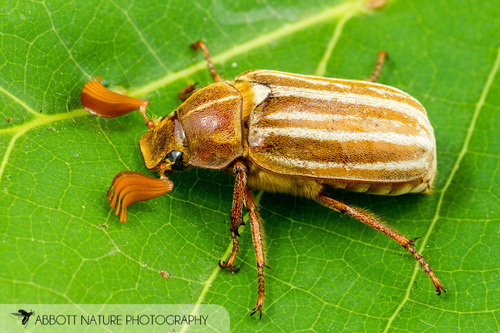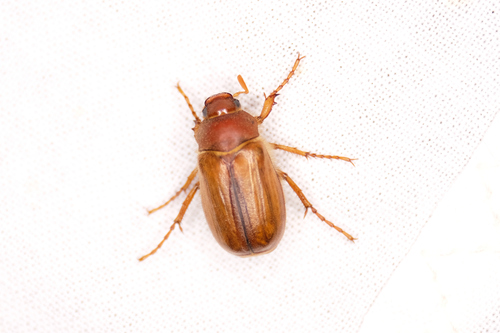
About Amphimallon majale (Razoumowsky, 1789)
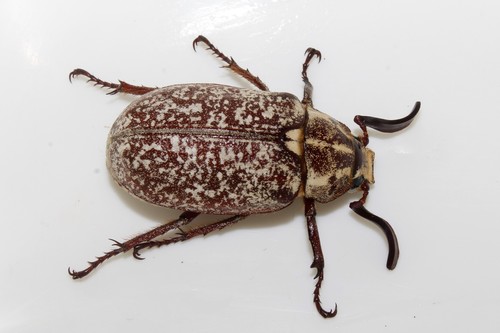
Amphimallon majale (Razoumowsky, 1789), commonly called the European chafer, was formerly classified as Rhizotrogus majalis. It is a species of beetle belonging to the family Scarabaeidae. Once restricted to continental Europe, this invasive species now inhabits temperate latitudes of North America. The large, white grubs of this species feed on the roots of nearly all cool-latitude grasses, both wild and cultivated, so the European chafer is considered a pest of lawns.
The European chafer has a one-year life cycle. The adult beetle (imago) stage is very short, lasting only 1 to 2 weeks. Adults emerge from the ground in late spring and mate in large swarms, typically on low trees and shrubs. They are most active on warm, clear nights when temperatures are above 19 °C (66 °F). Adults emerge around 8:30 pm, mate through the night, and return to the soil by daybreak. Over the mating period, beetles may return to the same trees to re-mate multiple times. Near the end of the mating period, adult carcasses often litter the ground beneath the trees the swarm used.
Female European chafers lay 20 to 40 eggs over the course of their lives. Eggs are laid individually 5 to 10 centimetres (2 to 4 inches) deep in moist soil, and take two weeks to hatch. Grubs hatch by late July. The grub population is mostly made up of first instars in early to mid-August, second instars by early September, and third instars by mid-September to early October. In regions with frost, grubs feed until November, then move deeper into the soil to overwinter. In frost-free regions, larvae feed continuously through the winter. Intensive feeding resumes from March through May. By early June, grubs move deeper again, into soil 5 to 25 centimetres (2 to 10 inches) deep, to form earthen cells and pupate. The pre-pupal stage lasts 2 to 4 days, and the pupal stage lasts two weeks, respectively. New adult beetles begin emerging by June.