About Amphidromus perversus (Linnaeus, 1758)
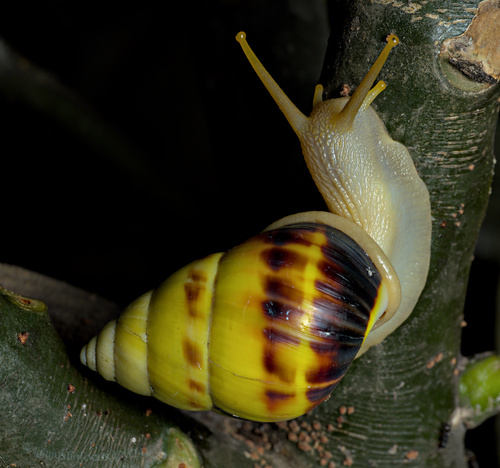
Amphidromus perversus (Linnaeus, 1758) is a species of land snail whose populations contain both left-handed and right-handed individuals, a trait called amphidrominy. Like most other thick-shelled species in the genus Amphidromus, this species has an internally thickened lip that forms a "roll" as it expands, and bears a very heavy parietal callus. Its shell is solid, polished, and moderately large, reaching 45–55 mm in height, and most individuals have a dark varix. The lip and callus are white, while the shell's base color ranges from white, orange, and yellow to yellowish-green. Many specimens have continuous or interrupted radial brownish streaks that cover part or all of the whorls of the lower spire and body whorl. Among all Amphidromus species, Amphidromus perversus has by far the largest set of discrete, variable color combinations. There are 12 recognized forms of color variation within the nominal subspecies Amphidromus perversus perversus: Amphidromus perversus perversus f. aurea Dillwyn, 1817 (not Martyn, 1784) is the name used for solid orange (rather than yellow) shells found in Java and Celebes; this variation is considered an individual trait. Amphidromus perversus perversus f. aureus Martyn, 1784 has no confirmed precise locality. It was described from three shells collected by Sir Joseph Banks, reportedly from Pulau Panaitan. The only Amphidromus species found on Pulau Panaitan, Amphidromus banksi Butot, is clearly distinct from this form, so the actual locality of f. aureus remains unknown. These shells have a wide white zone below the suture, similar to shells in the Amphidromus atricallosus complex, with yellow lower whorls that may or may not have narrow, wavy, reddish-brown flammulations. The original type specimens held in the Natural History Museum do appear to be a form of Amphidromus perversus, but their source locality is still unconfirmed. Note: Martyn's original work was invalidated by the International Commission on Zoological Nomenclature, and these varietal names do not have formal taxonomic status; the name aureus is only used as a convenient reference term. Amphidromus perversus perversus f. borneensis Pilsbry, 1900 is a stout variant of the interruptus color pattern, with a whitish background color, and is fairly similar to the Javanese subspecies emaciatus. It was first described from specimens collected in the Bandjermassin District of South Borneo (specimen catalog number Chicago Natural History Museum 63377), but additional specimens from East Borneo are held at Naturalis in Leiden. This variant has fewer flammulations above the shell's periphery. It is possible that this variant will eventually be recognized as a full subspecies, but there is currently not enough data available to confirm this status. Amphidromus perversus perversus f. infrapictus von Martens, 1867 was considered identical to interruptus Müller, 1774 by Pilsbry (1900). At most, it can be treated as a slightly different variant within an almost continuous series of color variations. Amphidromus perversus perversus f. infraviridis von Martens, 1867 is probably a derivative of the Celebesian infrapictus variant. Instead of having flammulations and a basal purplish zone, this variant has a pale green or greenish-yellow base that is only slightly darker than the greenish-yellow or citron-colored spire. It is most similar to the typical nominal form of the species, differing only in its darker basal portion. Amphidromus perversus perversus f. interruptus Müller, 1774 has a purplish or brownish zone on the shell base, a yellow or whitish patch near the columella, and brownish flammulations that are somewhat interrupted at the periphery and do not extend up to the suture. Amphidromus perversus perversus f. mitra von Martens, 1867 is an unfigured variant from Bali that appears to be intermediate between the interruptus and sultanus variants. It was originally described as a separate species, Amphidromus mitra. Its shell is short and conical in shape, with a striking golden yellow base color marked by broad reddish-chestnut brown stripes that rarely extend onto the upper portion of the body whorl. A more intensely golden yellow band is present, though it does not have sharply defined edges. Amphidromus perversus perversus f. niveus P. & F. Sarasin, 1899 is a solid snow-white form with a black varix and a black mark behind the peristome. It is an albino variant of A. perversus that is common in Celebes, and occurs sporadically in Java and Borneo. Amphidromus perversus perversus f. obesus von Martens, 1867 is an unfigured variant that most likely corresponds to squat individuals of the typical perversus color pattern. Amphidromus perversus perversus f. perversus Linnaeus, 1758, the nominal form, is a solid yellow shell with a black varix and a narrow black band behind the peristome. It occurs across the entire geographic range of the species. Amphidromus perversus perversus f. strigosus von Martens, 1867 has continuous, rather narrow, straight brown bands that run from the suture down to the base of each whorl. This variant is found in Bali, Borneo, and Celebes. Amphidromus perversus perversus f. sultanus Lamarck, 1822 has wavy brown bands that cover the entire whorl, with the bands interrupted in the middle of the whorl by a narrow spiral band of the ground base color. This variant occurs across the entire geographic range of the species. The natural distribution of Amphidromus perversus extends from Sumatra and Java to Borneo, Sulawesi, and Bali. The species is absent from the Mentawi Chain and Panaitan Island. Its reported occurrence on Sumbawa requires further confirmation. It is thought to have been introduced into Singapore. Recognized subspecies of this species occur in the Great Natuna, Bawean, Kangean, and Riau Islands.