About Ampelopsis glandulosa (Wall.) Momiy.
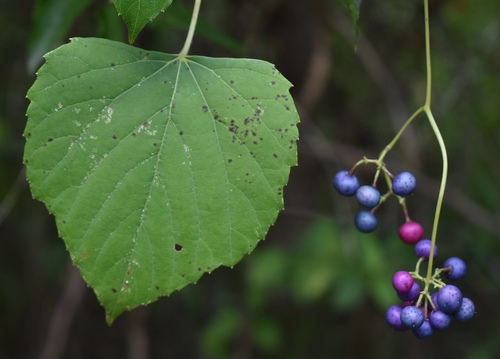
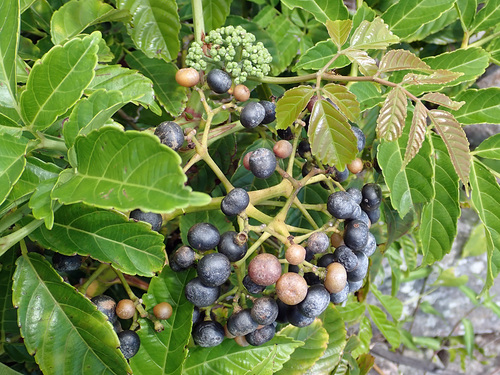
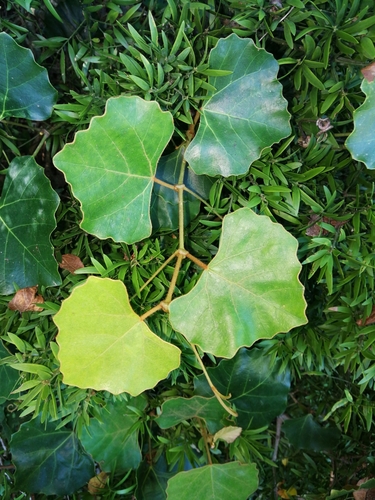
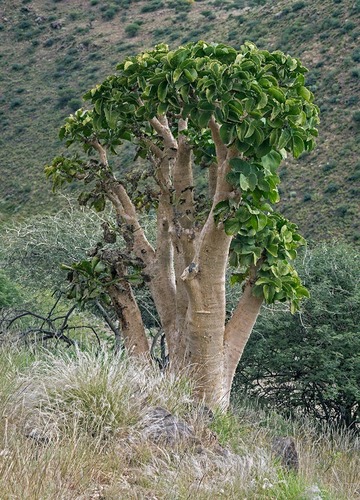
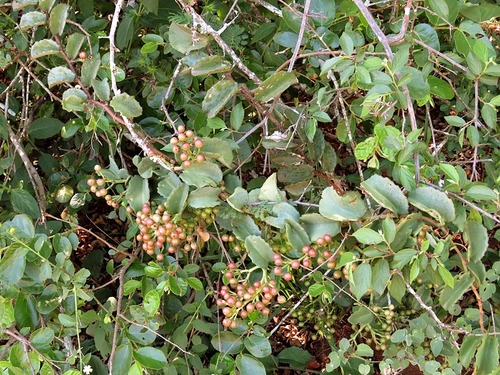
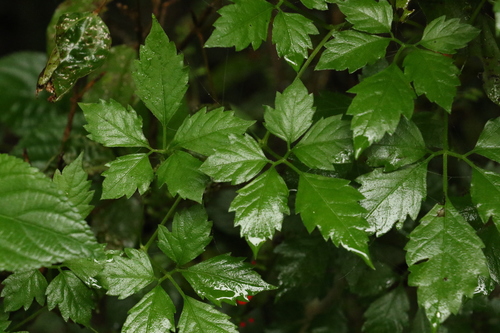
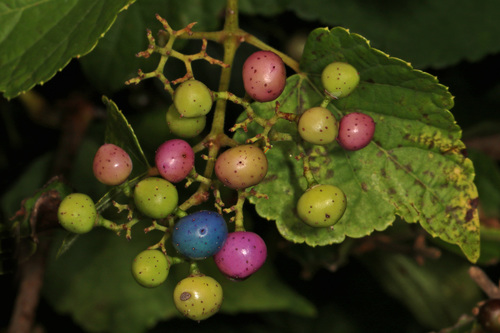
Ampelopsis glandulosa, commonly known as porcelain berry, is a deciduous, woody, perennial climbing vine. Its flowers and tendrils grow opposite palmately lobed leaves, which have three to five more or less deep lobes and coarsely toothed margins with a small apicule. It climbs via tendrils to a height of 4 to 6 metres (13 to 20 ft). The non-adhesive branching tendrils, which have two or three branches, cling to supports similarly to the tendrils of Vitis grape vines, and grow opposite the leaves. The inflorescence is a corymbiform cyme, attached opposite a leaf. Small green-white flowers grow in umbels opposite the leaves and bloom from June through August. Fruits are 4 to 8 millimetres (0.16 to 0.31 in) in diameter, round, and hold two to four seeds each. Fruits can come in many colors including green, blue, purple, pink or yellow, with black or brown speckles; many different colors can appear on the same plant. Berries ripen in late summer and fall, and seeds are dispersed by birds. Porcelain berry can be mistaken for native grapes due to its similar leaf shape, but it can be differentiated by examining stem pith and bark: native grapes have brown or tan pith, while porcelain berry has white pith; unlike grape bark, porcelain berry bark is covered in lenticels and does not peel. Porcelain berry grows primarily in marginal habitats, including forest edges, pond margins, stream banks, and thickets. It grows in areas with full sunlight to partial shade, and does not grow in permanently wet soils or heavily shaded areas. It is not typically found in the interiors of mature forests. It is native to China, Korea, Japan, and the Russian Far East. It was introduced to the United States in the 1870s as a landscape plant. Its invasive range in the U.S. extends from Wisconsin and Iowa at its westernmost extent to the Atlantic coastline in the east, where it occurs from New Hampshire to Georgia. Ampelopsis glandulosa var. brevipedunculata, which has distinctive medium blue fruit, is grown as an ornamental plant to cover walls and arbours in gardens. Despite being known to be invasive, it is still widely cultivated. If not properly managed, it will become dominant in an area, kill smaller trees, and climb larger trees all the way to their tops. The cultivated cultivar A. glandulosa var. brevipedunculata 'Elegans' is less vigorous than the species. It has smaller leaves that are mottled white and pink, and is more sensitive to frost. Porcelain berry often co-exists with Virginia creeper, poison ivy, and sassafras. Ampelopsis glandulosa is not commonly cultivated for culinary use, as its taste is unpleasant, described as slimy and bland. It is sometimes grown for medicinal use, particularly in China, where it is used to treat clots, boils, abscesses, ulcers, traumatic bruises, and aches. As of July 1, 2022, Ampelopsis glandulosa is banned in Delaware.