About Ampelion rubrocristatus (Orbigny & Lafresnaye, 1837)
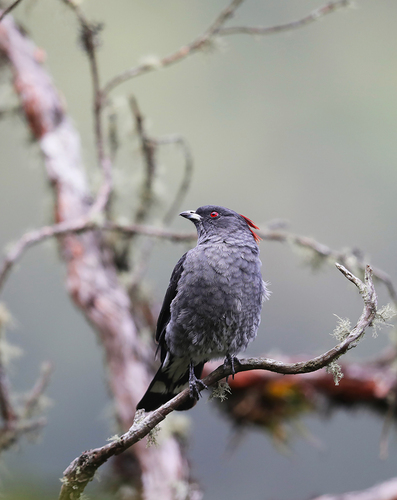
The red-crested cotinga, with the scientific name Ampelion rubrocristatus, measures 20.5 to 22 cm (8.1 to 8.7 in) in length and weighs 47 to 80 g (1.7 to 2.8 oz). Males and females have identical plumage. Adult individuals have a dark gray head with a long chestnut-maroon crest, which is usually held flat against the nape. Their body is gray, while their wings and tail are mostly a darker gray. Their upper- and undertail coverts, rump, and vent area have variable amounts of white streaking. The underside of their tail has a white band near its end. They have a deep red iris, a bill with an ivory-white or pale gray base and blackish gray tip, and black or dark gray legs and feet. Immature red-crested cotingas are overall paler than adults, because their feathers have pale fringes. This species has a disjunct distribution across northwestern and central South America. It occurs in the isolated Sierra Nevada de Santa Marta in northern Colombia, in the Serranía del Perijá along the Colombia-Venezuela border, in the Andes from northeastern Trujillo in Venezuela into the northern section of Colombia's Eastern Andes, and almost continuously along the Andes from Colombia's Central and Western ranges, extending south through Ecuador and Peru into Bolivia as far as Santa Cruz Department. In Peru, it is found on the western side of the Andes as far south as Ancash Department, and along the eastern side for most of the country's length. The red-crested cotinga lives in semi-open temperate zone landscapes, including cloudforest edges, humid woodlands (including Polylepis woodlands), páramo with scattered tree and shrub patches, and locally along the edges of agricultural areas that contain trees. Its elevation range differs by country: 2,500 to 3,250 m (8,200 to 10,700 ft) in Venezuela, 2,300 to 3,800 m (7,500 to 12,500 ft) in Colombia, mostly 2,500 to 3,500 m (8,200 to 11,500 ft) in Ecuador, and 2,400 to 3,700 m (7,900 to 12,100 ft) in Peru.