About Ampelioides tschudii (G.R.Gray, 1846)
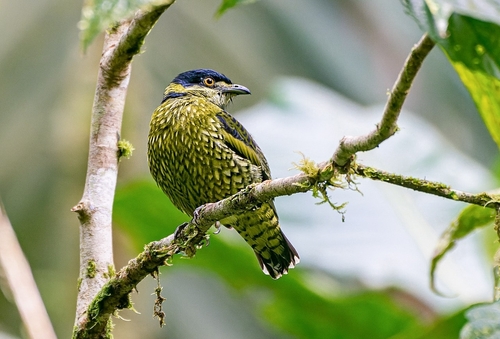
The scaled fruiteater, scientifically named Ampelioides tschudii (G.R.Gray, 1846), has the following physical characteristics. It has olive-green plumage with fine scaling across its chest and belly. Its beak is short and sharp, specialized for eating fruits, seeds, and insects. Males have an entirely black head, more vibrant green body coloration, and longer tails than females. This species is distributed in the montane forests of the Andes mountains. It inhabits dense rainforests, where it stays below the canopy, often close to streams or other water sources. It occurs at high elevations, ranging from 1,000 to 3,500 meters (3,300 to 11,500 ft) above sea level. In terms of behavior and ecology, scaled fruiteaters feed on a variety of fruits and berries native to the South American mountain ranges. They add insects to their diet during the breeding season, when protein-rich food is necessary for raising young. These birds have notable camouflage ability, using their green scaled plumage to stay hidden in dense vegetation. The scaled fruiteater is non-migratory, and remains in the Andes region year-round. During the breeding season for reproduction, males establish territories and attract female mates through vocalizations and aerial displays. They build a shallow cup-shaped nest from plant fibers. Females typically lay two eggs, which are incubated for approximately two weeks. Both parents take part in feeding and caring for the chicks until the chicks develop wings large enough to fly.