About Amorphophallus titanum (Becc.) Becc.
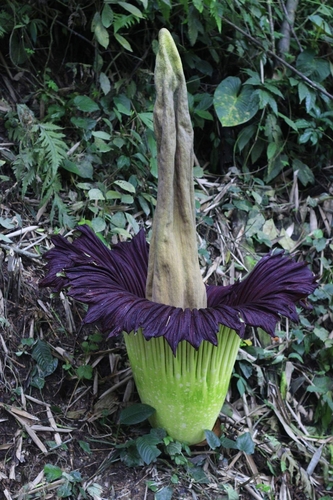
The titan arum, with the scientific name Amorphophallus titanum, is a flowering plant in the Araceae family. It produces a large unbranched inflorescence, a tall single tree-like branched leaf, and a heavy tuber that supports inflorescence growth. This species is endemic to rainforests on the Indonesian island of Sumatra. Its blooms are both infrequent and short-lived, and the flower releases a strong scent of rotting flesh to attract pollinators. This characteristic classifies it as a carrion flower, giving it the common names corpse flower or corpse plant. Titan arum was first successfully brought into bloom in cultivation at the Royal Botanic Gardens, Kew in 1889. Since that time, it has bloomed at many botanic gardens. It remains difficult for amateur gardeners to cultivate, though one individual bloomed at Roseville High School in California in 2011. Blooms of this species often draw crowds of thousands of in-person visitors, and in the 21st century, they also attract thousands of viewers via Internet live streaming. Amorphophallus titanum was first scientifically described in 1878 by Italian botanist Odoardo Beccari. Beccari discovered the species on 6 August 1878 in rainforest growing on the hills above Priaman, Western Sumatra, and brought a dried inflorescence, tubers, and seeds back to Europe. The first leaf specimen was collected at Air Mancur, located west of Padang Panjang. Beccari initially named the species Conophallus titanum in 1878, in a letter published anonymously on his behalf under the title "Il Conophallus titanum—Beccari". In 1879, Giovanni Arcangeli published a full description of the species and reclassified it into the genus Amorphophallus. All species in the Amorphophallus genus have a single locule inside the ovary, and the genus is distributed across tropical Africa, India, Southeast Asia, Japan, Indonesia, Papua New Guinea, and Australia. A. titanum itself is endemic to western Sumatra, where it grows in rainforest openings on limestone hills. Its geographic range is shrinking due to climate change and habitat loss, with population hotspots located in the southern Aceh and Sumatera Utara provinces. As the spathe opens gradually, the spadix warms to 37 °C (99 °F) and releases its powerful scent in a rhythmic pattern to attract carrion insects, which feed on or lay their eggs in rotting meat. The scent grows stronger from late evening through the middle of the night, when pollinating carrion beetles and flesh flies are active, then fades by morning. Chemical analysis of compounds released by the spadix shows the stench includes dimethyl trisulfide (which smells like limburger cheese), dimethyl disulfide (garlic), trimethylamine (rotting fish), isovaleric acid (sweaty socks), benzyl alcohol (a sweet floral scent), phenol (similar to Chloraseptic), and indole (which smells like faeces). The scent can be detected from as far as 800 m (0.50 mi) away. The inflorescence's deep red colour and texture reinforce the impression that the spathe is a piece of meat. During bloom, the tip of the spadix reaches roughly human body temperature, which helps the scent compounds volatilize. The warm spadix creates micro-convection in the cool surrounding air, improving scent distribution. The heat also helps convince carrion-feeding insects that a dead body is present, drawing them to the inflorescence. Titan arum first bloomed in cultivation in 1889 at the Royal Botanic Gardens, Kew, London, grown from a single seedling that Kew received from Beccari. The first recorded blooms in the United States occurred at the New York Botanical Garden in 1937 and 1939. These blooms drew thousands of in-person visitors, and in the 21st century, they attract thousands of Internet live stream viewers as well. This popularity inspired the designation of titan arum as the official flower of the Bronx in 1939, a status it held until it was replaced by the day lily in 2000. The Botanical Garden of Bonn has cultivated titan arum since 1932. The number of cultivated titan arum plants has increased as cultivation requirements for garden-grown specimens are now well understood, and it has become common in the 21st century for five or more blooms to occur in gardens around the world in a single year. Difficult cultivation requirements mean the plant is still rarely grown by amateur gardeners. Even so, in 2011, Roseville High School in California became the first school in the world to get a titan arum to bloom, and this same plant bloomed again in September 2020. The heaviest recorded titan arum tuber was grown at the Royal Botanic Garden Edinburgh in 2010; after seven years of growth from an initial tuber the size of an orange, it weighed 153.9 kg (339 lb). The tallest documented inflorescence grew at Meise Botanic Garden, reaching 3.225 metres (10.58 ft) in height on 13 August 2024. In cultivation, titan arum generally needs five to ten years of vegetative growth before it produces its first bloom. After the first bloom, there is substantial variation in how often the plant blooms. Some plants may not bloom again for another seven to ten years, while others bloom every two or three years. At the Botanical Garden Bonn, plants bloomed every other year when grown under optimal conditions. A plant at the Copenhagen Botanical Garden has bloomed every second year from 2012 to 2022. Unusual bloom patterns have been recorded, including consecutive blooms within a single year, and a tuber producing both a leaf (or two leaves) and an inflorescence at the same time. Triplet inflorescences have been recorded in Bonn, Germany from a 117 kg (258 lb) tuber, and at the Chicago Botanic Garden in May 2020. Titan arums have bloomed at three of Indonesia's botanical gardens: Bogor, Cibodas, and Purwodadi. Self-pollination was once thought impossible, but in 1992 botanists in Bonn successfully hand-pollinated their plant with its own pollen, using ground-up male flowers. The process produced fruit and hundreds of seeds, which were used to grow numerous seedlings that were distributed to other collections. In 2011, a titan arum at Gustavus Adolphus College in Minnesota produced viable seed through natural self-pollination.