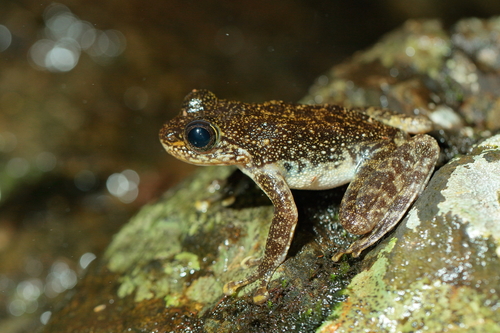
About Amolops hongkongensis (Pope & Romer, 1951)
Amolops hongkongensis is a frog species first described by Pope & Romer in 1951. Both adult males and females reach a snout–vent length of 40 mm (1.6 in), while tadpoles grow up to 25 mm (0.98 in) in length. The suction discs on this species have a diameter 3 to 4 times the width of its fingers. The species has a tarsal fold, and males have white velvety nuptial pads on their first fingers. This species was originally described from a population found on Tai Mo Shan in Hong Kong, and populations are now also known to occur in Guangdong, China. Within Hong Kong, it is found in the New Territories and on Hong Kong Island, and has specifically been recorded in small streams in Lung Fu Shan. Amolops hongkongensis lives in small, forest-fringed hill streams, especially streams with cascades. Tadpoles of this species have a ventral sucker that helps them hold their position in fast-moving stream water. The species' habitat is currently threatened by silviculture, clear-cutting, and the construction of dams and other infrastructure projects.