About Ammotragus lervia (Pallas, 1777)
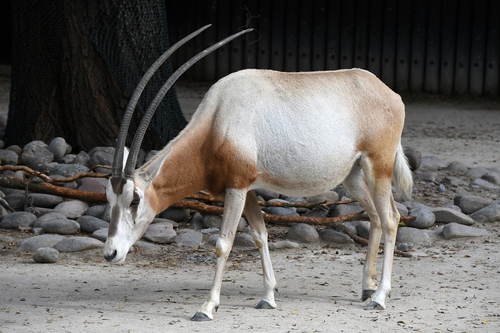
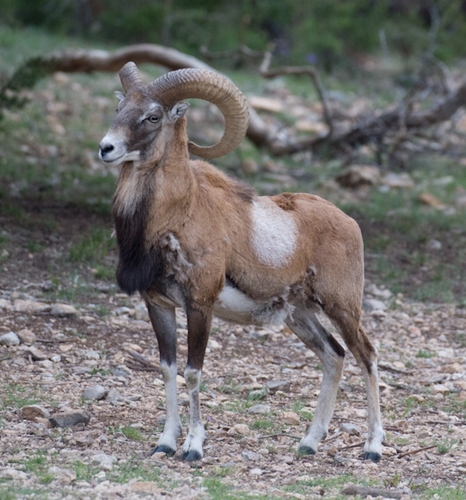
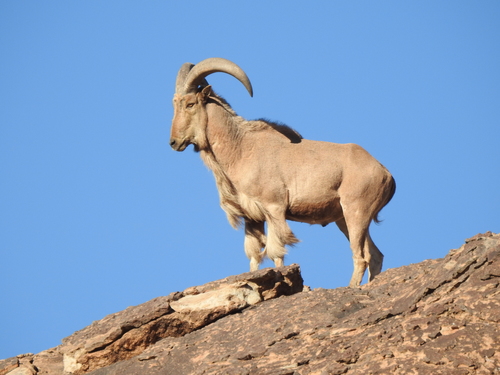
Barbary sheep (Ammotragus lervia (Pallas, 1777)) stand 75 to 110 cm (2 ft 6 in to 3 ft 7 in) tall at the shoulder, measure around 1.5 m (5 ft) in length, and weigh 30 to 145 kg (66 to 320 lb). Their coat is sandy-brown, which darkens as the animal ages, with a slightly lighter underbelly and a darker line running along the back. The upper body and outer parts of the legs are a uniform reddish-brown or grayish-brown. Shaggy hair grows on the throat, extending down to the chest in males, and the species has a sparse mane. Barbary sheep horns have a triangular cross-section; they curve outward, then backward, then inward, and can reach over 76 cm (30 in) in length. The horns are fairly smooth, with slight wrinkles visible at the base as the animal matures. Barbary sheep are endemic to regions of Northern Africa that primarily surround the barren center of the Sahara Desert. Countries and territories where aoudad (Barbary sheep) may be found include Algeria, northern Chad, Egypt, Libya, northern Mali, Mauritania, Morocco, Niger, Tunisia, and Western Sahara. West of the Nile, they occur in Sudan; east of the Nile, they are found in the Red Sea Hills. The now-extinct Ancient Egyptian corkscrew-horned sheep (Ovis longipes palaeoaegyptiacus) was also thought to be a subspecies of wild Barbary sheep. Within their native range, Barbary sheep populations have been decreasing due to hunting, both legal and illegal, and habitat destruction.