About Ammospermophilus leucurus (Merriam, 1889)
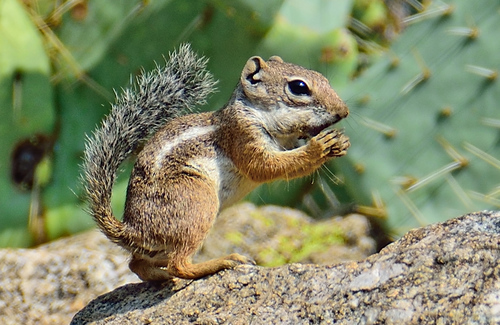
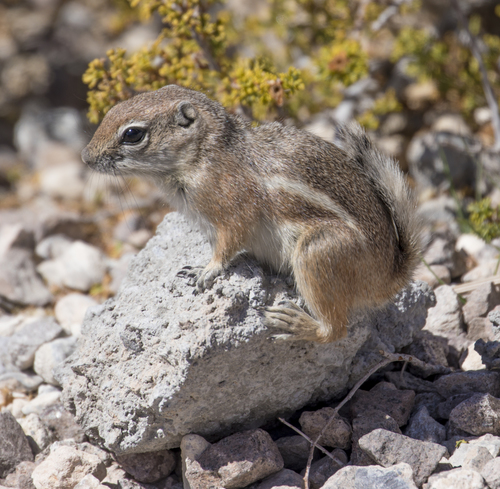
The white-tailed antelope squirrel, scientifically named Ammospermophilus leucurus, is a diurnal ground squirrel species belonging to the order Rodentia and family Sciuridae. It is found in arid regions of the southwestern United States and the Baja California Peninsula of northwestern Mexico.
Geographically, its range extends from southwestern Oregon in the north to New Mexico in the south, and from western Colorado in the east to Baja California, Mexico in the west. This species has an average home range of 14.9 acres (60,000 m2), and uses around 4 acres (16,000 m2) for its daily activities. Across most of its range, particularly in Utah, population density fluctuates widely, alternating between periods of high and low density. Average population density also changes with the seasons, reaching higher levels in autumn compared to late spring.
Geographical and associated environmental factors have a strong impact on the length of this species' reproductive cycle and its average litter size. This variation is most clear when comparing the northern and southern ends of its distribution. At the northernmost extent of the range in Oregon, reproductive cycles are relatively short, and the average litter size is 9.3. At the southernmost extent in Baja California, reproductive cycles last half the year, and the average litter size is 5.9.
In terms of ecology, the white-tailed antelope squirrel is commonly found in arid habitats across the southwestern United States. Throughout its range, A. leucurus is omnivorous. Its diet consists primarily of 10% to 60% foliage and 20% to 50% seeds, plus arthropods, and to a lesser degree vertebrates (mainly lizards and rodents; predatory behavior in this ground squirrel species has been recorded). As well as acting as a predator, the white-tailed antelope squirrel is prey for many larger animals, including raptors, various canids, and snakes. In addition to being hunted by large predators, these squirrels host a wide diversity of ectoparasites, including multiple types of ticks, fleas, mites, lice, and a couple of species of parasitic larvae.