About Ammospermophilus harrisii (Audubon & Bachman, 1854)
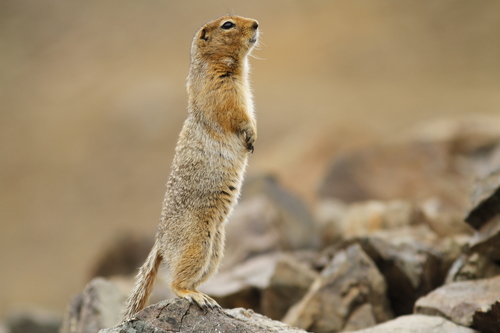
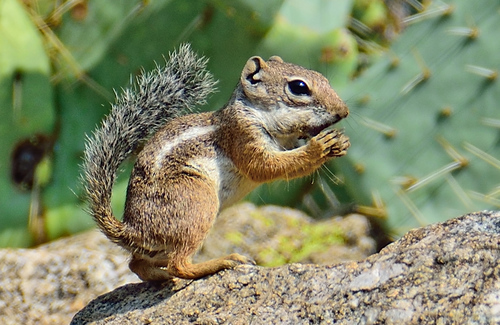
Ammospermophilus harrisii, first described by Audubon & Bachman in 1854, is named after Edward Harris. Individuals of this species have distinctive markings on their grey fur, with brown highlights on the sides and legs, a white stripe running down the side of the torso, and a white ring encircling the eyes. Their fur is longer in winter than in summer. Adult A. harrisii weigh around 4–5 ounces (110–140 g), and measure 8.5–10 inches (22–25 cm) excluding the tail, which measures 3–4 inches (7.6–10.2 cm). They can be mistaken for chipmunks. This species has a high body temperature ranging from 97 to 107 degrees Fahrenheit (36.7 to 41.6 °C). To protect itself from the heat of the Sonoran Desert, A. harrisii holds its tail over its body to provide shade. It also uses a heat reduction method called "heat dumping", where individuals move to shaded spots and lie spread-eagled against the ground. They are active during the day, do not sweat, and reduce their body temperature by salivating. The optimal reproductive period for A. harrisii falls between February and March, though mating can occur any time between December and June. Gestation lasts thirty days, and females usually produce one litter per year with an average of 6.5 pups. Newborns reach adult size around 217 days after birth, and both males and females reach sexual maturity within their first year. The habitat of A. harrisii spans the Southwestern United States, specifically Arizona and southwestern New Mexico. Its range extends outside the US into northwestern Sonora, Mexico. The Arizona Game and Fish Department designates A. harrisii as a non-game animal. While the species is not endangered, the size of its habitat range is being reduced by human development. Its diet includes the fruit and seeds of local cactus plants, and mesquite beans. It is not exclusively herbivorous, and also consumes insects, small rodents, and carrion. Its predators include bobcats, coyotes, local snakes, and domestic animals such as dogs and cats.