About Ammoperdix heyi (Temminck, 1825)
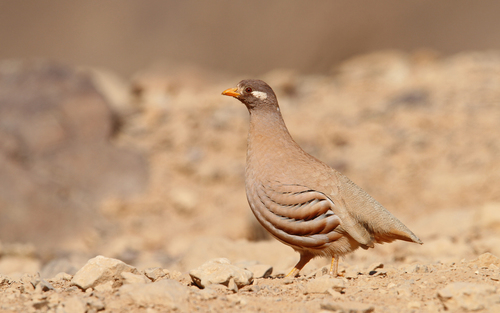
The sand partridge (Ammoperdix heyi (Temminck, 1825)) is a rotund bird, with primarily sandy-brown plumage marked by wavy white and brown stripes along its flanks. It measures 22–25 cm in length, weighs 180–200 g, and has a wingspan of 39–41 cm. It can live up to 4 years. When disturbed, this species prefers to run rather than fly, but will fly a short distance on rounded wings when necessary. Its call is a slurred kwa-kwa-kwa. Sand partridges are endemic to the Middle East. Their populations are found across Eastern Egypt, Eastern Sudan, Israel, Jordan, Saudi Arabia, Yemen, Oman, and the United Arab Emirates (UAE). Four subspecies of sand partridge are native to separate regions of the Middle East. Ammoperdix heyi heyi ranges from the Jordan Valley through the Egyptian Sinai Peninsula to Saudi Arabia. Ammoperdix heyi nicolli occurs across Northern Egypt. Ammoperdix heyi cholmleyi is distributed from Egypt to Northern Sudan. Ammoperdix heyi intermedius ranges from Western Saudi Arabia to Yemen, extending east into Oman and reaching the Musandam Peninsula in the UAE. Sand partridges inhabit desert ecosystems with scattered vegetation and boulders. They favor steep, boulder-strewn slopes alongside sandy-bottomed wadis, occupying ridges up to 2000 m above sea level and valleys as low as 400 m below sea level. They are rarely found in large expanses of dry, flat, open desert, as they require access to a drinking water source. This is a non-migratory species, so it breeds and remains in these habitats year-round. Breeding timing varies by location. In Israel, sand partridges breed between February and August. In Jordan and the Sinai Peninsula of Egypt, females lay eggs between March and April, while egg laying occurs only in April across the North African region. On the Arabian Peninsula, most egg laying takes place in March and April, though laying can occur as late as August to November in Oman and Yemen. Sand partridges are thought to be primarily monogamous, but nests have been observed only 30–70 m apart in Israel, which suggests that one male may mate with multiple females, a reproductive strategy called polygyny. Nests are constructed in three main forms. Some nests are sparsely lined with grass, feathers, small pieces of wood, or pebbles. Others are built under the cover of a bush or rock and left unlined. The third type of nest is built in hollows or crevices at the base of cliffs. Females lay between 5–14 pale grey or pink eggs. Two females may share the same nest to lay their eggs. Only females incubate the eggs, which hatch after roughly 21–24 days. Newly hatched chicks are covered in white down, with grey coloration on the upper breast and a pale throat. Chicks fledge between 9–20 days after hatching, and reach full adult size at 30 days old. Sand partridges are typically found in groups of several dozen individuals, though multiple families may gather to form large flocks of up to 70 members in late summer or early autumn.