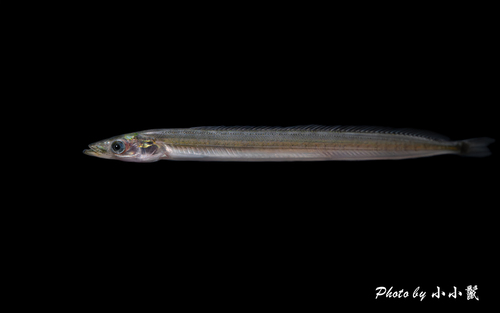
About Ammodytes americanus DeKay, 1842
Like all sand lances, Ammodytes americanus has a long, thin body with a pointed snout. Mature individuals typically reach 4 to 6 inches (10 to 15 cm) in length, though some can grow as large as 7 inches (18 cm). It has a long, low, very delicate dorsal fin that runs along most of its back, and can fold into a groove at the fin's base when not in use. Its anal fin is approximately the same height as the dorsal fin, and spans the posterior third of the fish's body. Its pectoral fins are small, and its caudal fin is forked. It has a large, toothless mouth, with a lower jaw that extends noticeably past the upper jaw. Fish caught from more northern waters of the Northwest Atlantic usually grow to a larger maximum length than those caught in southern NWA waters. Its overall body color is greenish silver, with countershading camouflage: a muted brownish-green dorsal side that transitions to white on the sides and stomach. The visible lateral line runs down the body through this color transition, ending at the caudal peduncle. The operculum is silvery white, matching the color of the stomach. Its eyes are silvery with a dark pupil, and all fins are pale brown and hard to see on the fish. When swimming, Ammodytes americanus uses a sinusoidal, eel-like movement. Swaying undulations begin at the head and travel down the length of the body. This anguilliform movement pattern makes the fish highly mobile, allowing it to shimmy away across the benthic floor to evade predators. Ammodytes americanus is distributed in the Northwest Atlantic region, from Cape Hatteras, North Carolina, north to Labrador. Historically, it has been recorded in bays, estuaries, and shallow coastal waters less than two meters deep. Suitable habitat for this species requires coarse substrate that it can burrow into. Preferred substrates include clean sand or gravel grains, as well as crushed shell. This preference may stem from larger grains being easier to move through, and this type of substrate being able to hold more dissolved oxygen.

