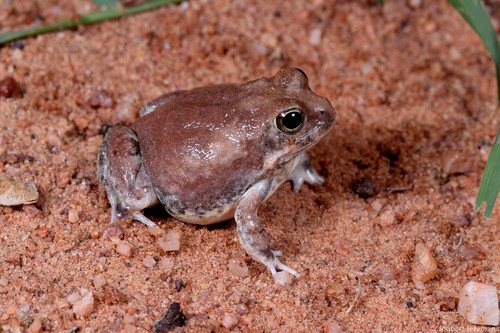
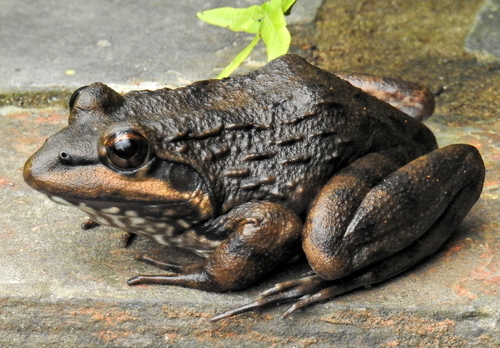
About Amietia delalandii (Duméril & Bibron, 1841)
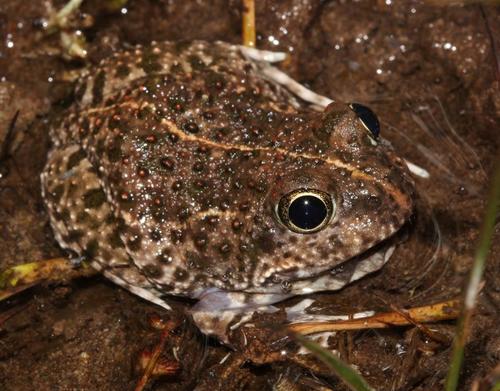
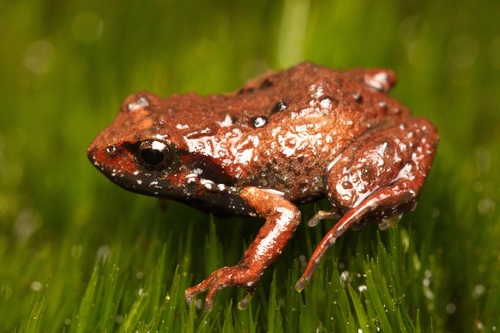
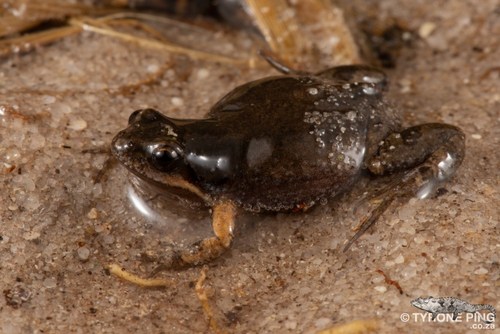
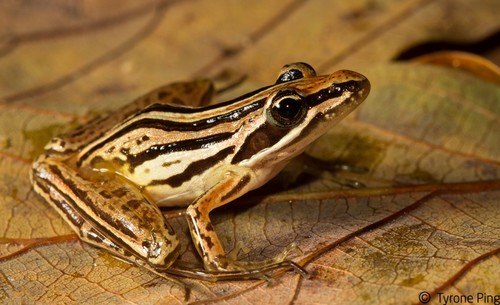
All river frogs have streamlined bodies with pointed snouts, and live near water. Amietia delalandii, a river frog species, has well-developed hind legs; when disturbed, it leaps rapidly into water and can stay submerged there for long periods. Males grow to a snout-urostyle length of 58 mm (2.3 in), while females reach 83 mm (3.3 in). Their toes are partially webbed. Their colouration is variable, but typically the dorsum ranges from dull brown to bright green, over a pale brown background with orange flecks, and is covered in small dark brown blotches. Roughly half of all individuals have a prominent pale vertebral stripe. The tympanum has a diameter more than half that of the eye, is dark, and has pale flecks. The gular area is usually marbled, and this marbling extends to the chest; the rest of the underside is unmarked and uniformly pale. The male’s advertisement call is a short series of frequency-modulated clicks, followed by a pause and a brief croak. Males may call either singly or in groups. Amietia delalandii is distributed from the highlands of southern and eastern Lesotho up to over 2,000 m above sea level, in Natal in the permanent mountain streams that originate from the Drakensberg Escarpment, and is widely distributed across most of South Africa, excluding the country’s dry west. As a high-altitude stream breeder, this species is vulnerable to infection by the fungus Batrachochytrium. It is an adaptable species, and can be found along large and small rivers, in savanna, forest fringes, and grasslands, and in ornamental ponds, at elevations ranging from 200–1,500 m (660–4,920 ft) above sea level. This species lays eggs individually in slow-moving to still water, and its tadpoles are bottom feeders.