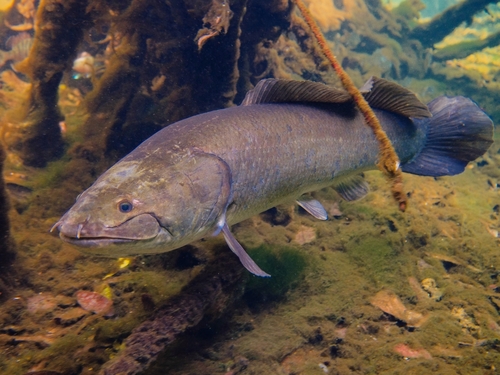
About Amia calva Linnaeus, 1766
Amia calva, commonly called bowfin, has an average typical length of 50 cm (20 in). Females usually grow to between 65 and 70 cm (26 to 28 in), while males reach 50 to 65 cm (20 to 26 in); females are generally larger than males. Maximum recorded length is 109 cm (43 in), with a maximum recorded weight of 9.75 kg (21.5 lb). Young of the year typically reach 13–23 cm (5.1–9.1 in) by October. The bowfin has an elongated, cylindrical body. Its back and sides are olive to brown, often marked with vertical bars, dark reticulations, or another camouflaged pattern. The dorsal fin has horizontal bars, and the caudal fin has irregular vertical bars. The underside is white or cream, and the paired fins and anal fin are bright green. Larval hatchlings with a total length of about 7–10 mm (0.28–0.39 in) are black and tadpole-like in appearance. At roughly 25 mm (0.98 in) total length, they have been described as looking like miniature placoderms. Bowfin grow quickly, and typically leave the nest within 4 to 6 weeks after hatching. Young males have a black eyespot on the caudal peduncle (tail base) that is usually surrounded by an orange-yellow border; females’ eyespots are black if present at all. The eyespot is thought to confuse predators, diverting attacks away from the bowfin’s head to its tail, giving the fish an opportunity to escape predation. The species is named bowfin for its long, undulating dorsal fin, which is made of 145 to 250 rays and runs from the middle of the back to the base of the tail. The bowfin skull has two layers: the outer dermatocranium and the inner chondrocranium. The chondrocranium cannot be seen from the outside, as it lies below the dermal bones. The dermatocranium is made of 28 fused bones. The roof of the mouth is composed of three bones: the ectopterygoid, the palantine, and the vomer. Bowfin have two sets of teeth: one set of larger, sharp teeth grows from the mandibular and premaxillary bones, used to grasp and control prey. The second set is located posteriorly and connected to the hyomandibular bone; this set consists of pharyngeal tooth patches, which sort nutrients and grind larger pieces of food. The lower jaw is made of three bones: the dentary, the angular, and the surangular. The cranial surface of the skull is formed by the nasals, antorbital, lacrimal, parietal, intertemporal, post parietal, supratemporal, extra scapular, post temporal, and opercular bones. The entire skull is attached to the shoulder girdle via another set of bones. Bowfin are often called "living fossils" or "primitive fish" because they retain several primitive ancestral characteristics, including a modified heterocercal caudal fin that is externally rounded, a highly vascularized gas bladder lung, vestiges of a spiral valve, and a bony gular plate. The bony gular plate is located underneath the head on the outside of the lower jaw, between the two halves of the lower jaw bone. Other distinguishing traits include long, sharp teeth, and two protruding tube-like nostrils. Unlike the most primitive actinopterygians, bowfin do not have ganoid scales. Instead, they have large, single-layered cycloid scales that are more similar to the scales of more derived teleost fish. Fossil deposits show that extinct amiiforms included both freshwater and marine species that were once widely distributed across North America, South America, Eurasia, and Africa. Today, the genus Amia contains just two surviving species, the only remaining members of the order Amiiformes. Bowfin are demersal freshwater piscivores, and their current range is restricted to freshwater habitats in North America, covering most of the eastern United States and adjacent southern Canada. Their range extends west from the St. Lawrence River and Lake Champlain drainages of southern Ontario and Quebec, around the Great Lakes in southern Ontario to Minnesota. Historically, their North American distribution included the Mississippi River drainage basin from Quebec to northern Minnesota, the St. Lawrence-Great Lakes system (including Georgian Bay, Lake Nipissing and Simcoe, Ontario), south to the Gulf of Mexico; it also covered the Atlantic and Gulf Coastal Plain from the Susquehanna River drainage in southeastern Pennsylvania to the Colorado River in Texas. Bowfin prefer vegetated sloughs, lowland rivers and lakes, swamps, and backwater areas, and are occasionally found in brackish water. They are well camouflaged, and difficult to spot in slow water with abundant vegetation. They often shelter under roots and submerged logs. They can tolerate oxygen-poor environments because they are able to breathe air. Bowfin spawn in spring or early summer, usually between April and June, most often at night. Spawning occurs in clear, shallow water with abundant vegetation, in weed beds over sand bars, and also under stumps, logs, and bushes. The optimum temperature for nesting and spawning ranges from 16–19 °C (61–66 °F). Males build circular nests in fibrous root mats, clearing away accumulated leaves and stems. Depending on the density of surrounding vegetation, nests may have a tunnel-like entrance on one side. Nests commonly have a diameter between 39–91 cm (15–36 in), and are built at a water depth of 61–92 cm (24–36 in). During spawning season, the fins and underside of male bowfin often turn bright lime green. The courtship and spawning sequence lasts one to three hours, and can repeat up to five times. Courtship begins when a female approaches the nest. The ritual involves intermittent nose bites, nudges, and chasing behavior from the male until the female becomes receptive. Once receptive, the pair lie side by side in the nest. The female deposits her eggs while the male shakes his fins in a vibratory movement, and releases his milt to fertilize the eggs. A single male’s nest often contains eggs from multiple females, and a single female often spawns in several different nests. After spawning, females leave the nest, and the male stays to guard the eggs during the 8 to 10 day incubation period. A nest may hold 2,000 to 5,000 eggs, and sometimes more. Fecundity is usually related to the size of the fish, so a large, gravid female may carry over 55,000 eggs, which is not unusual. Bowfin eggs are adhesive, and stick to aquatic vegetation, roots, gravel, and sand. After hatching, larval bowfin do not swim actively to search for food. Over the 7 to 9 days required for yolk sac absorption, they attach to vegetation using an adhesive organ on their snout, and remain protected by the parent male. Bowfin aggressively protect their spawn from the first day of incubation through around one month after hatching. Once fry are able to swim and forage on their own, they form a school and leave the nest, accompanied by the parent male who slowly circles around them to keep the school together. Bowfin reach sexual maturity at 2 to 3 years of age. They can live up to 30 years in captivity. In some areas of the United States with elevated toxin levels (including mercury, arsenic, chromium, and copper) in aquatic environments, public signs warn against consuming fish caught in these areas. Mercury concentration biomagnifies as it moves up the food chain from organisms at lower trophic levels to apex predators, and bioaccumulates in the tissues of larger, long-lived predatory fish. Compared to smaller, shorter-lived fish, bowfin tend to accumulate higher levels of mercury, which makes them less safe for human consumption.

