About Ameiurus natalis (Lesueur, 1819)
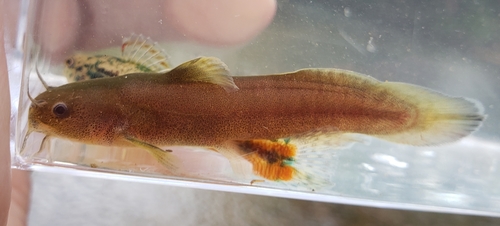
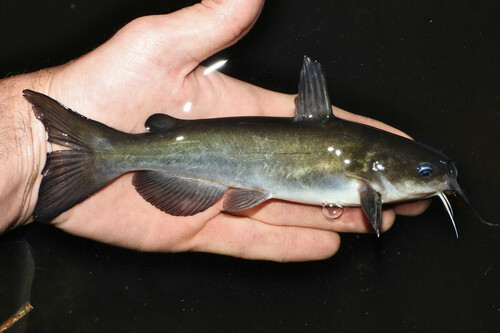
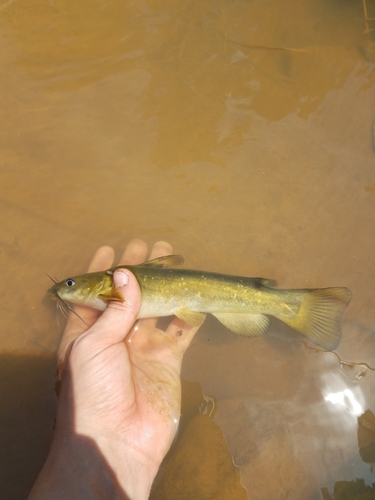
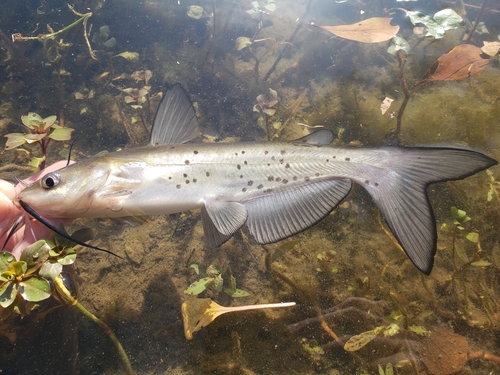
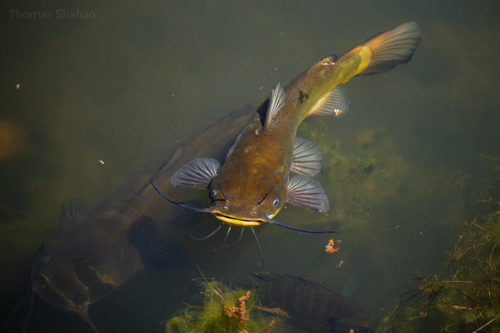
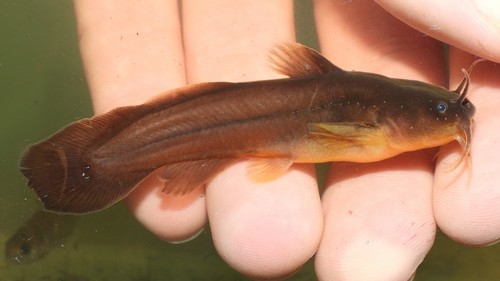
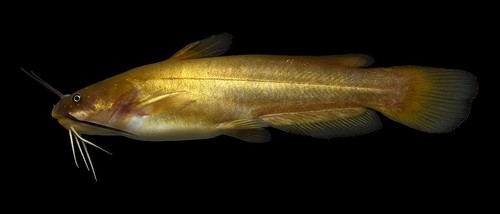
The yellow bullhead (Ameiurus natalis (Lesueur, 1819)) is a medium-sized member of the catfish family. Its back is typically yellow-olive to slate black, and may appear mottled depending on habitat, though its mottling is generally less pronounced than that of the brown bullhead (Ameiurus nebulosus). Its sides are lighter and more yellowish, while the underside of its head and body ranges from bright yellow, to yellow white, to bright white. The rear edge of its caudal fin is rounded. Its anal fin contains 24 to 27 constituent rays, more than the anal fin of other bullheads. The yellow bullhead can be easily distinguished from A. nebulosus and the black bullhead (A. melas) by the set of white barbels, or "whiskers", under its chin. Its pectoral spines have posterior barbs, matching the pectoral spines of the brown bullhead. Unlike flathead catfish (Pylodictis olivaris), there are no lateral extensions on its upper (premaxillary) tooth patch. Its eyes are generally smaller than those of the snail bullhead (A. brunneus) or the flat bullhead (A. platycephalus), and there is no blotch at the base of the dorsal fin. Yellow bullheads are medium-sized bullheads that rarely grow larger than 2 lb (0.91 kg), but can reach a maximum weight of 6 lb 6 oz (2.89 kg). They can grow to a maximum total length (TL) of 60 centimetres (24 in), though they are more commonly found at 22.5 centimetres (8.9 in) TL, and can live up to 12 years. Yellow bullheads are bottom-dwelling fish that live in areas with muck, rock, sand, or clay substrates. Their habitat includes river pools, backwaters, and areas with sluggish current over soft or mildly rocky substrate in creeks, small to large rivers, and shallow portions of lakes and ponds. Their habitat can range from slow-moving, poorly oxygenated, highly silted, heavily polluted water, to faster-moving, clean clear water that contains aquatic vegetation. Fishermen commonly find them in sluggish creeks and rivers with a gravel bottom. Yellow bullheads have a wide native range across central and eastern United States, extending from the Rio Grande River to North Dakota and south-eastern Canada, and east through the Great Lakes region to the East Coast. They have also been introduced to the western United States, and can be caught as far north as northern Washington state. Yellow bullheads form monogamous pairs for breeding, and spawning begins in mid-May or early June. Both sexes participate in building the nest. Bullheads usually build nests in a natural cavity, or create saucer-shaped depressions near submerged cover such as tree roots or sunken logs. The female lays 300 to 700 eggs at a time in a gelatinous mass, with a total of up to 4300 eggs deposited in a single nest. After fertilization, the male protects and continuously fans the egg nest. Eggs hatch after an average of 5 to 7 days. The male herds newly hatched fry into tight schools, and both parents protect the young until they are approximately two inches long. Young yellow bullheads grow to about three inches by one year of age. They reach sexual maturity after two to three years, at which point they are typically 140 millimetres (5.5 in) in length. Ameiurus natalis can act as a host for glochidia, the larvae of Unionidae freshwater mussels, specifically those of Cyclonaias tuberculata, Tritogonia verrucosa and Strophitus undulatus. It is also parasitized by leeches.