About Ameiurus catus (Linnaeus, 1758)
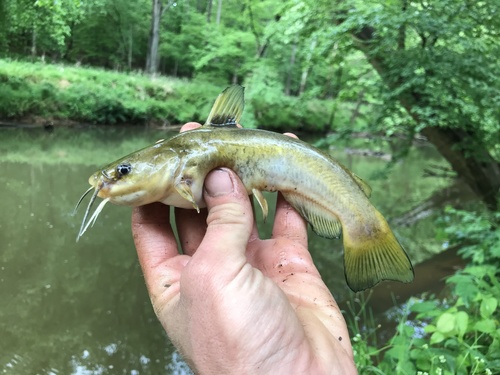
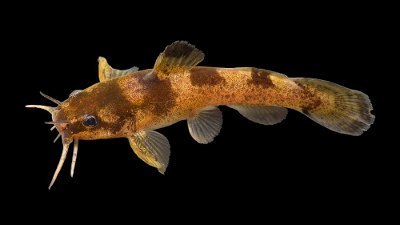
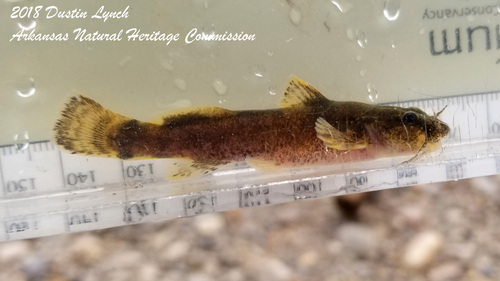
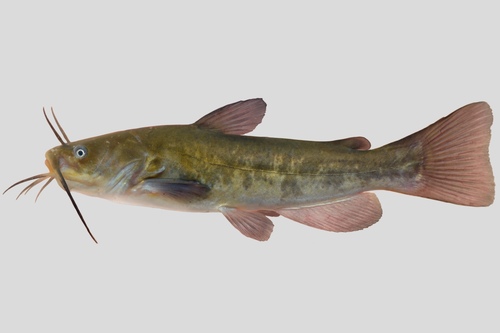
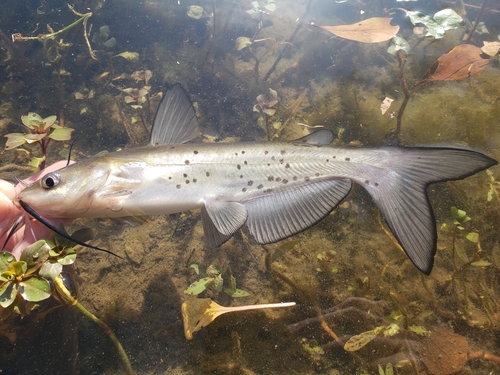
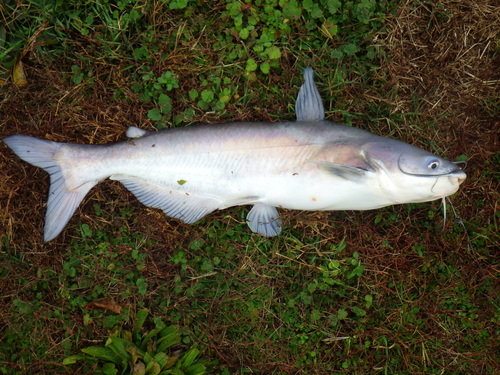
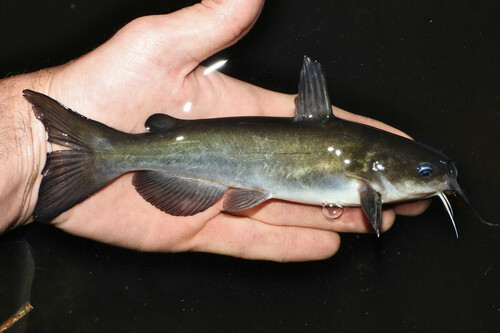
Ameiurus catus (white catfish or white bullhead) has eight barbels on its head: two nasal, two maxillary, and four chin. This species is scaleless, and has a spine on the anterior edge of both its dorsal and pectoral fins. It usually has six dorsal soft rays, and does not have palatine teeth. Individuals typically weigh between 0.5 and 2.0 pounds (0.23 and 0.91 kg), but can reach weights of over 10 pounds (4.5 kg). Like the closely related yellow bullhead (Ameiurus natalis), A. catus has light-colored chin barbels. Unlike A. natalis, which has a rounded or truncate tail, A. catus has a forked tail. Compared to channel catfish (Ictalurus punctatus), mature A. catus typically has a larger head relative to its body width, and a shorter anal fin relative to its body length, with 22 to 24 anal rays. White bullhead is native to river systems of the Eastern United States, ranging from the Hudson River in New York south to the Peace River in Florida, and west to the Apalachicola River in Florida. It may have migrated naturally into Connecticut rivers due to its salt tolerance. It has been widely introduced elsewhere as a food and game fish. It was intentionally stocked near Stockton, California in 1874, and has since become established there. It has also been introduced and established in the Columbia River basin and Puerto Rico. It was reportedly introduced to the Philippines but failed to establish a population there. Escapees from fee-fishing ponds and stocked lakes have led to the establishment of white bullhead in Missouri. Ameiurus catus prefers sluggish, mud-bottom pools and backwaters of rivers and streams, and thrives in lakes and large impoundments. Reproduction takes place from April to July, when water temperatures are between 65 and 75 °F (18 and 24 °C). Females deposit a gelatinous mass of eggs into cavities formed by hollow logs or undercut banks. The male guards the nest and incubates the eggs by continually fanning fresh water over them. Predation by introduced white bullheads contributed to the extirpation of Sacramento perch (Archoplites interruptus) from Thurston Lake by 1970. The commercial white bullhead fishery in California was closed in 1953 due to concerns about overfishing, and the state of California does not currently consider the species to be an invasive species.