About Ameiurus brunneus Jordan, 1877
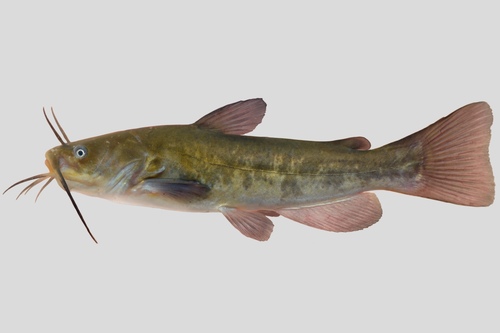
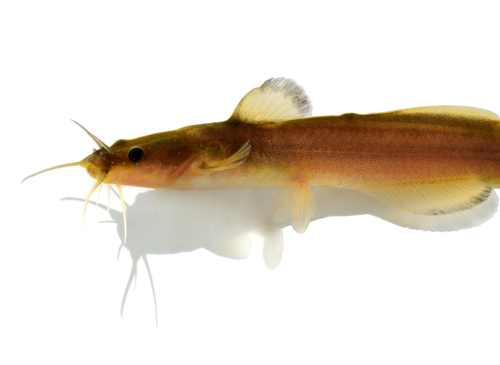
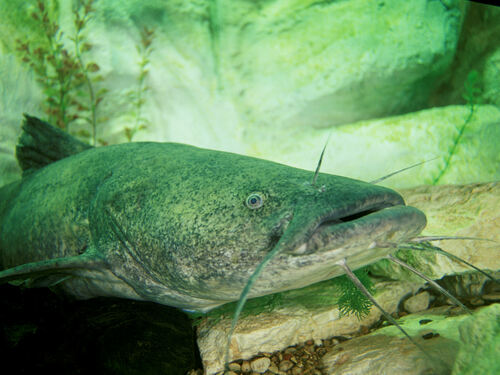
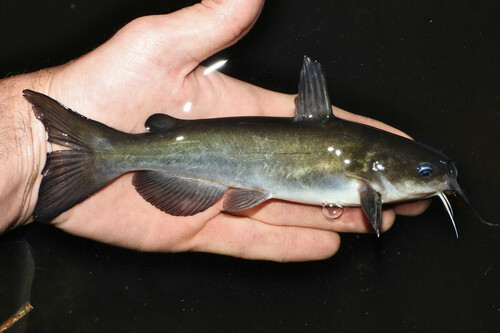
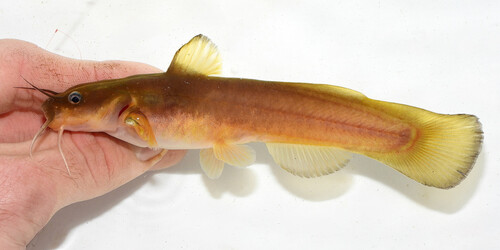
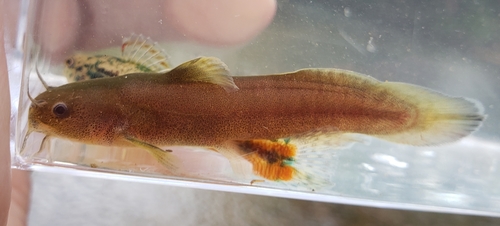
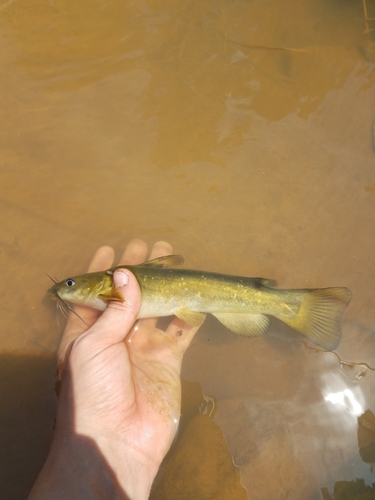
Description: The snail bullhead (Ameiurus brunneus) reaches an adult length of about 11.4 inches (29 cm) in fluvial habitats, and can grow up to 17.6 inches (45 cm) in disturbed habitats like reservoirs and impounded rivers. Like other North American ictalurids, it has a flat head, eight maxillary mouth barbels, a rounded anal fin, an emarginate tail, two pectoral fins, an adipose fin, and a scaleless body. The anal fin of A. brunneus usually has 17 to 20 fin rays, which is fewer than the related flat bullhead (A. platycephalus), though some individuals can have as many as 22 rays. This species has three spines: one on the dorsal fin and two on the pectoral fins. These spines are coated in a toxic irritant that causes local pain and swelling, acting as a defense against predators. The pectoral spines have fine serrations but no coarse teeth, a trait that distinguishes snail bullheads from spotted bullheads (A. serracanthus). Body color varies widely among individuals, but the most common forms have brown to yellow-green backs, mottled sides, and a white belly. There is a dark spot or bar at the base of the dorsal fin. Snail bullheads are ectothermic, bilaterally symmetrical, and nocturnal. Distribution: The snail bullhead is native to the southeastern United States, and occurs primarily from Virginia to Florida, extending west through Alabama. The northernmost extent of its range on the Atlantic slope is the Dan River in Virginia, stretching south to the Altamaha River system in Georgia, and ending at the St. John's River drainage in Florida. It also occurs in Gulf drainages including the Apalachicola River Drainage. Within Georgia, its range covers the Tennessee, Coosa, Chattahoochee, Flint, Satilla, Ocmulgee, Oconee, Altamaha, Ogeechee, and Savannah River basins. The species is relatively common throughout its native range. In South Carolina, it is most abundant in smaller streams of the upper Santee drainage, and is rarer in coastal streams. Its highest abundance occurs in the Broad River Basin, where introduced species are absent. Habitat: The snail bullhead is a habitat generalist. It has been found in shallow, slow water, and prefers deep, fast water. It can be found in riffles, runs, and pools, as well as in streams, rivers, and lakes. As a nocturnal species, it prefers cover under rocks and wood structures during the day, and forages out in the open in riffles at night. It prefers fast-flowing water in high gradient streams for the water's purity and clarity, but can also live in stagnant water.