About Amegilla cingulata (Fabricius, 1775)
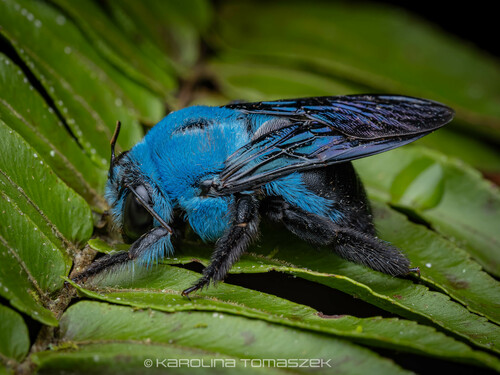
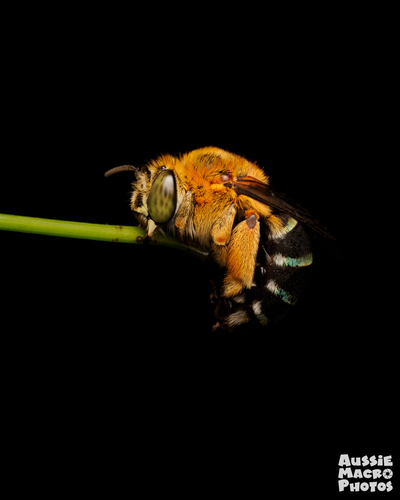
Amegilla cingulata has a very striking appearance similar to many other species in the Amegilla genus. Unlike honey bees, it has pale opalescent blue stripes across its abdomen. Males can be distinguished from females by the number of complete abdominal bands they have: males have five, while females have four. Adult Amegilla cingulata reach a size of 10–12 mm (0.39–0.47 in).
In terms of distribution and habitat, Amegilla cingulata is found in both coastal and inland areas of New South Wales, Queensland, Victoria, the Australian Capital Territory, South Australia, and Western Australia. All reports of this species occurring outside Australia, including in Papua New Guinea, Indonesia, East Timor, Malaysia, and India, are incorrect. It occupies tropical, subtropical, and temperate regions, and inhabits urban areas, woodlands, forests, and heathlands.
For its life cycle, Amegilla cingulata builds solitary nests, though these nests are often located close to nests of other members of the same species. The bees typically nest in burrows dug into dried-up river banks, old clay homes, and mortar between bricks. They may also burrow into soft sandstone, and suitable areas of this rock can become completely riddled with the species' tunnel nests. At the end of each tunnel are individual brood cells, each holding one egg along with a mixture of pollen and nectar that serves as food for the developing larva.