About Ambystoma talpoideum (Holbrook, 1838)
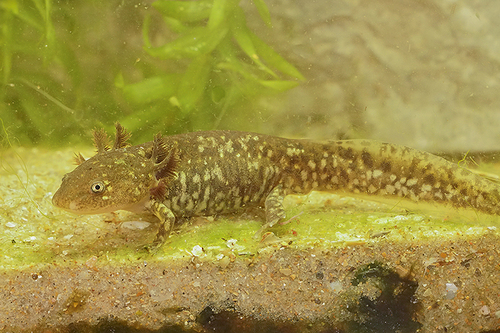
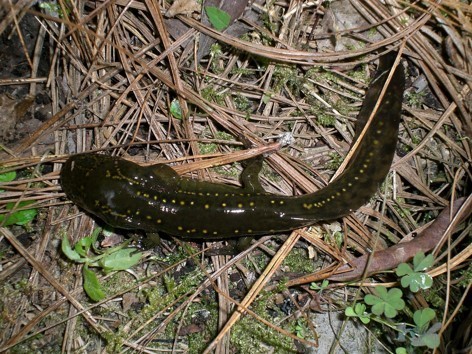
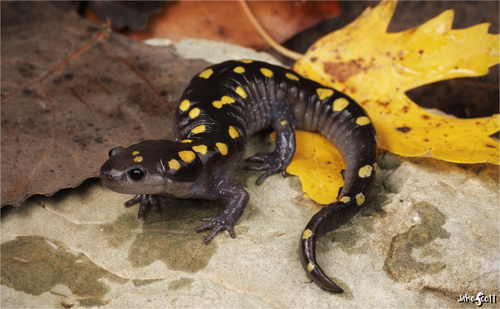
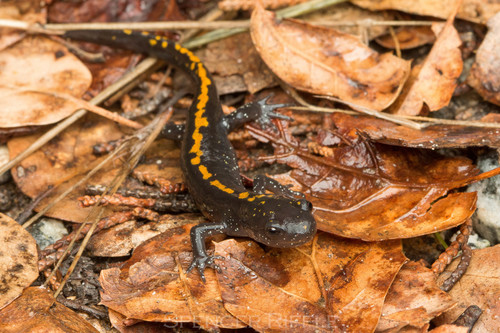
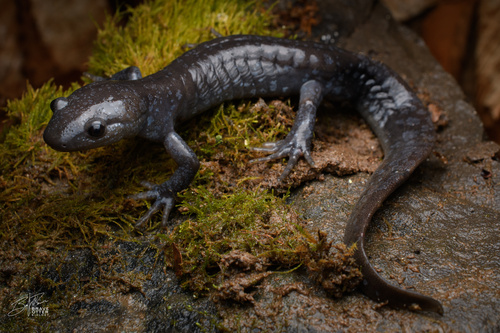
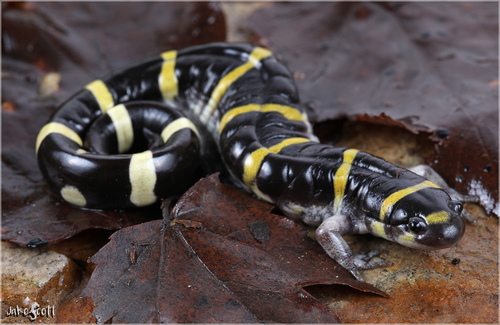
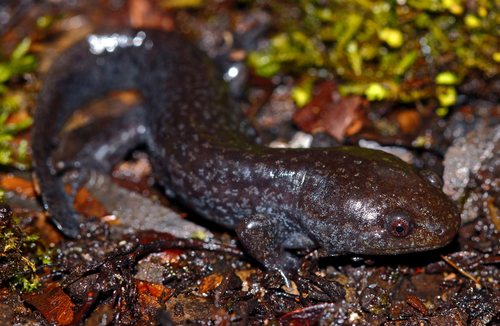
This mole salamander, Ambystoma talpoideum, has a stocky build with a short body and large head. Adult length ranges from 4.5 to 10.9 cm (1.8 to 4.3 in), and weight ranges from 3.5 to 10.5 g. Its base color is typically gray or dark brown, with darker mottled patterning and lighter gray undersides. Males can be identified by their swollen cloaca. Aquatic larvae and paedomorphic adults have large, feathery gills. Larvae of A. talpoideum can be distinguished from the larvae of other salamander species by the two light stripes on their underside.
These mole salamanders are found in the lowland southeastern portion of the United States' Gulf Coastal Plains. Their main continuous range stretches from eastern Texas to southern South Carolina, and extends inland as far as southern Illinois. The species is absent from southern Florida and Louisiana. Separate populations exist in Kentucky, Virginia, Tennessee, North Carolina, northern South Carolina, northern Georgia and northern Alabama. A small, isolated population is also located at the southernmost tip of Indiana. They live in floodplain pine or broadleaf forests, particularly near gum and cypress ponds. Adult mole salamanders stay under leaf litter, while larvae live in water, found in ponds and fish-free ephemeral waters. The size of terrestrial adult populations is directly limited by the density of shelters such as burrows, logs, and crevices, which the salamanders need for shelter, thermoregulation, and avoiding desiccation.
Mole salamanders breed between October and March, in semi-permanent ponds that have surrounding areas with suitable burrowing space and enough food. Males are less likely to mate in areas that have multiple rival males.