About Ambystoma opacum (Gravenhorst, 1807)
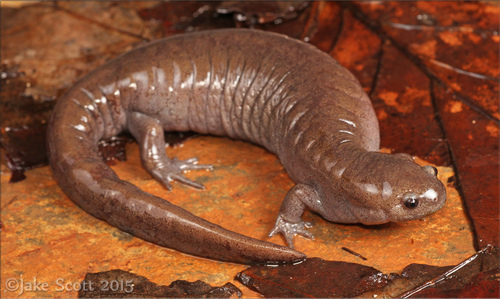
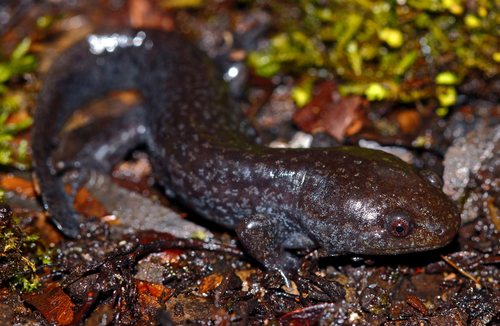
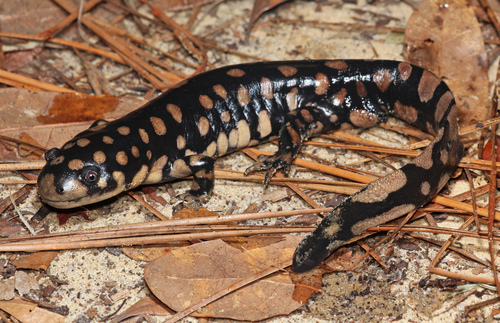
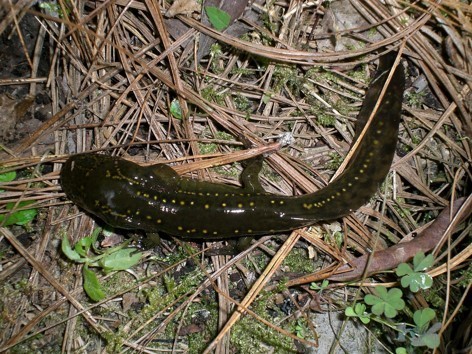
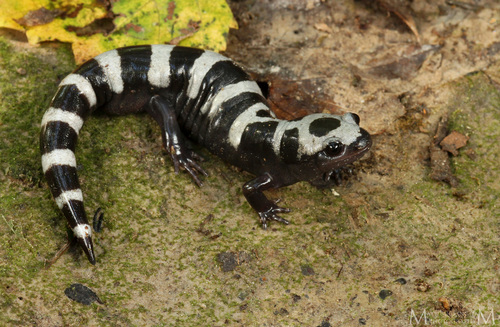
The marbled salamander, Ambystoma opacum, is a stout-bodied species marked with black and light-colored bands across its body. This species shows clear sexual dimorphism: females have light gray bands, while males have bright white bands. Males also have a larger percentage of white coloration on their dorsal surface compared to females. Females tend to have more asymmetrical dorsal markings, whereas males have more symmetrical markings. Like all salamanders, marbled salamanders undergo metamorphosis and have an aquatic larval life stage. Juveniles start with small white flecks, which develop into full bands as the salamanders reach adulthood. Adults can grow to approximately 11 cm (4 inches) in total length, making this species smaller than most other members of its genus. Like most mole salamanders, the marbled salamander is secretive, and spends most of its life under logs or in underground burrows. Marbled salamanders are native to the eastern United States, ranging from southern New England south to northern Florida, and west to Illinois and Texas. They occupy damp woodlands, forests, and areas with soft, wet soil. While adults are fully terrestrial, seasonally flooded areas are required for this species to breed. Like many salamander species, marbled salamanders have poison glands that help them deter predators. The marbled salamander is the official state salamander of North Carolina. In late summer and early autumn, marbled salamanders migrate to seasonal pond basins, where they court and lay eggs. Courtship for this species occurs entirely on land. Males compete for mates by butting heads and blocking other males’ movement with their tails. When courting a female, a male nudges the female’s vent with his snout, prompting the female to nudge him back. This repeated back-and-forth nudging, during which the pair circles one another, looks like a dance. Mating success depends only on this courtship display, and has no connection to the size of the salamander. The display ends when the male deposits a spermatophore, which the female then takes into her cloaca. After mating, the female lays between 50 and 200 eggs, and often stays with the clutch until the nest floods. A distinctive parental care behavior of marbled salamanders is that guarding mothers wrap their bodies around their eggs to form a bowl shape that collects water over the clutch. Eggs require extended contact with water to begin hatching. Nest site choice is important for reproductive success. Marbled salamanders typically prefer nesting sites at mid to high elevations, and soil moisture levels also influence nesting site selection. However, females have been observed abandoning their eggs before the nest floods. Female marbled salamanders have very low attachment to their eggs, and will abandon the nest after a disturbance. They have even been recorded abandoning undisturbed nests. When a mother abandons her nest, the eggs become vulnerable to predation by other salamanders, frogs, and beetles. Marbled salamander reproductive success varies widely. One study found that eggs laid in the deepest and shallowest parts of ponds had lower survival than eggs laid in areas at the pond’s mean water level. In some years many juveniles survive, while in other years the breeding population experiences total catastrophic failure, with very few juveniles surviving. These catastrophic failures happen randomly, and are primarily driven by the length of the pond’s hydroperiod, the period each year when the pond holds water. A short hydroperiod is the leading cause of catastrophic reproductive failure. Because marbled salamanders have relatively long lifespans, the risk of extinction from occasional catastrophic failure is low. If they do not breed successfully one year, they will survive to the next year to attempt breeding again. However, if other stressors already affect the population’s survival, catastrophic failure poses a greater threat to the overall population. Survival on land outside of the breeding season is very important for keeping marbled salamander populations stable. While most marbled salamanders return to the pond where they hatched to breed, some individuals travel more than 1,000 meters to breed in a new pond. This most often happens when the natal pond has a small population that does not offer a large enough choice of mates. This dispersal helps marbled salamander populations avoid genetic issues by introducing new genes into local groups. It also means that these salamanders should be considered as part of a larger metapopulation, rather than managing or studying only single isolated wetland populations. Marbled salamander larvae are positively phototactic, meaning they move toward light, until they fully develop their rear legs. Once their rear legs are fully developed, larvae switch to become negatively phototactic, moving away from light.