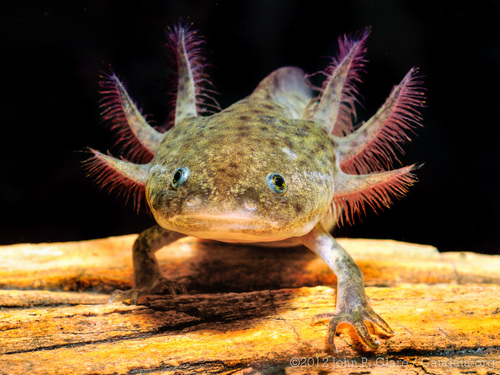
About Ambystoma mexicanum (Shaw & Nodder, 1798)
Sexually mature adult axolotls (Ambystoma mexicanum) reach maturity between 18 and 27 months of age, and range in length from 15 to 45 cm (6 to 18 in). A length close to 23 cm (9 in) is most common, while lengths over 30 cm (12 in) are rare. Axolotls retain features typical of salamander larvae into adulthood, which is a form of neoteny; these features include external gills and a caudal fin that extends from behind the head to the vent. Most salamander species lose their external gills when they reach sexual maturity, but axolotls keep this trait. Axolotls have wide heads, lidless eyes, underdeveloped limbs, and long, thin digits. Three pairs of external gill stalks (called rami) grow behind their heads, and function to move oxygenated water. These stalks are lined with filaments called fimbriae that increase surface area to support more efficient gas exchange. Four gill slits lined with gill rakers are hidden beneath the external gills; these slits stop food from entering the lungs and allow unwanted particles to filter out. Male and female axolotls can be easily distinguished: males have swollen cloacae lined with papillae, while gravid females carrying eggs have noticeably wider bodies. Axolotls have barely visible vestigial teeth, which only develop during metamorphosis in other salamander species. Their primary feeding method is suction; during this process, their gill rakers interlock to close the gill slits. Axolotls primarily use their external gills for respiration, but they may also use buccal pumping, which involves gulping air from the surface to supply oxygen to their lungs. Buccal pumping can happen in a two-stroke pattern that moves air from the mouth to the lungs, or a four-stroke pattern that reverses this pathway using compression force. The naturally occurring wild type axolotl is brown or tan with gold speckles and an olive undertone. They can subtly change their color by altering the relative size and thickness of their melanophores, an adaptation that is thought to help with camouflage. Axolotls have four pigmentation genes; mutations in these genes produce many different color variants. The five most common mutant color variants are leucistic (pale pink with black eyes), xanthic (grey with black eyes), albino (pale pink or white with red eyes), melanistic (all black or dark blue, with no gold speckling or olive tone), and piebald. There is also wide individual variation in the size, frequency, and intensity of gold speckling, and at least one variant develops a black and white piebald pattern once it reaches maturity. Because pet breeders often cross different color variants, double homozygous mutants are common in the pet trade; this is especially true for white or pink axolotls with pink eyes, which are double homozygous mutants for both the albino and leucistic genes. The axolotl genome has 32 billion base pairs, and its full sequence was published in 2018. This was the largest completed animal genome at the time of publication, and the sequence revealed species-specific genetic pathways that may be responsible for axolotl limb regeneration. While the axolotl genome is around 10 times larger than the human genome, it encodes a similar number of proteins: specifically 23,251 proteins, compared to around 20,000 proteins encoded by the human genome. The large size difference is mostly explained by a high fraction of repetitive sequences. These repeated elements also lead to increased median intron sizes: axolotl introns average 22,759 base pairs, which is 13 times the median intron size in humans, 16 times that in mice, and 25 times that in the Tibetan frog. Today, axolotls are widely used as model organisms in biological research, and large numbers are bred in captivity. They are particularly easy to breed compared to other salamanders in their family, which are rarely captive-bred because their terrestrial life stages have complex husbandry requirements. One key feature that makes axolotls useful for research is their large, easily manipulated embryo, which allows researchers to observe the full development of a vertebrate. Axolotls are used in studies of heart defects, because a specific mutant gene causes heart failure in axolotl embryos. These embryos survive almost until hatching even with non-functional hearts, making the heart defect very easy to observe. Additional research uses the axolotl heart as a model for the human single ventricle and excessive trabeculation. Axolotls are also considered an ideal animal model for studying neural tube closure, because the formation of the neural plate and tube is very similar between humans and axolotls. Unlike the neural tube of frogs, the axolotl neural tube is not hidden under a layer of superficial epithelium. There are also axolotl mutations that affect other organ systems; some of these mutations are well characterized, while others are not. The genetics of axolotl color variants have also been widely studied. Axolotls are also a major model organism for studying whole limb regeneration. Researchers have identified the apical-ectodermal ridge (AER, a fundamental embryonic growth structure) and the apical-ectodermal cap (AEC) as key contributors to axolotls' ability to regenerate whole limbs during early development. The apical ectodermal ridge is an embryonic structure that initiates appendage growth by signaling how appendages should be shaped and extended. These cells are required to form limbs in most tetrapods, including amphibians and humans. Unlike most other animals, the AEC in axolotls can send signals via growth hormones to activate blastema cells, which can then rebuild entire amputated or damaged limbs and organs. Studying the differences in capability between AER and AEC is important for understanding regeneration. Research into the axolotl AEC could reveal why most animals heal with scar tissue instead of regrowing lost limbs. The unique genetic basis of axolotl regeneration provides an extraordinary system for studying whole-body regeneration; understanding this process could help researchers develop new methods to help humans heal more effectively after serious injury.