About Ambystoma mavortium Baird, 1850
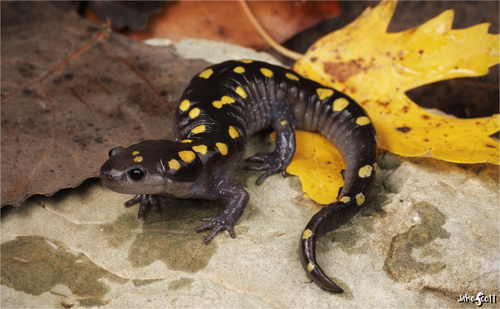
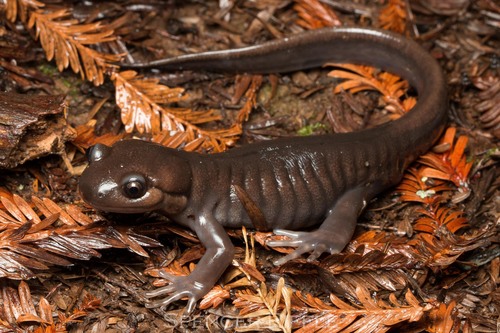
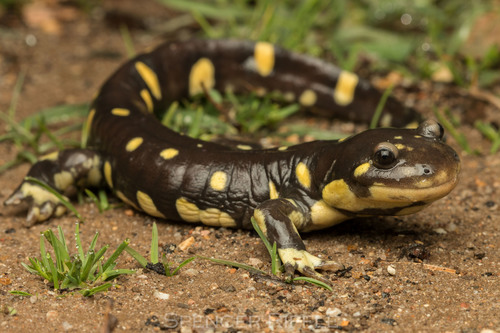
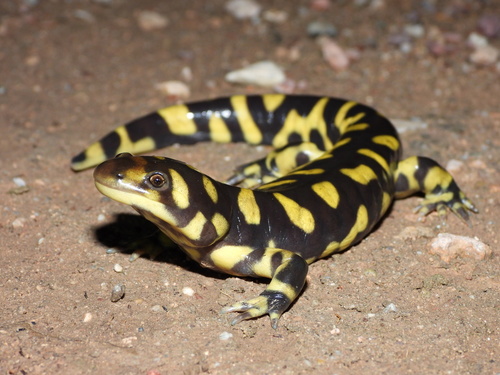
The barred tiger salamander (scientific name Ambystoma mavortium Baird, 1850) is one of the largest salamander species native to North America. Typically, adult terrestrial individuals grow between 7.6 and 16.5 cm (3.0 to 6.5 inches) in length, while neotenic forms can reach 17.8 to 38.1 cm (7.0 to 15.0 inches). This species has a broad head and a sturdy body. Its base color varies across its range: the dorsal (upper) surface is grey, dark brown, or black, marked with muddy yellow bars and spots that create a distinctive tiger-like pattern. The ventral (lower) surface ranges from light to dark in color. Larvae have alternating dark and light blotches down the center of their dorsal surface, plus pale stripes running along their sides. According to Kansaspedia, barred tiger salamanders have been recorded living over 20 years in captivity. The barred tiger salamander's natural range covers western Canada and the western half of the United States, though it occurs only infrequently in California and Nevada. In Canada, it is found in British Columbia, Alberta, Saskatchewan, and Manitoba. In the United States, its range extends south to the southernmost tip of Texas, and does not reach further east than the Dakotas and Oklahoma. This species has been introduced into southern Arizona, because its larvae are used as fish bait. It is primarily a terrestrial species that lives in lowland deciduous forests, coniferous forests, and woodlands. It also inhabits open fields, rough ground, upland meadows, grasslands, deserts, semideserts, and streams.