About Ambystoma maculatum (Shaw, 1802)
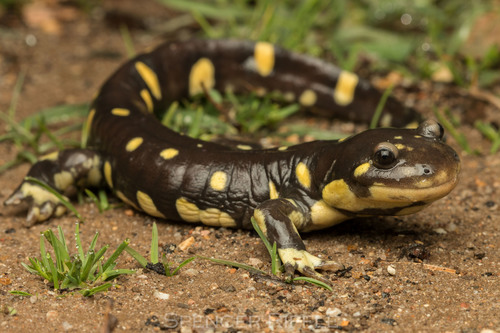
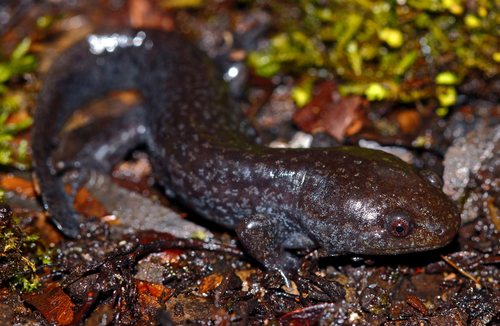
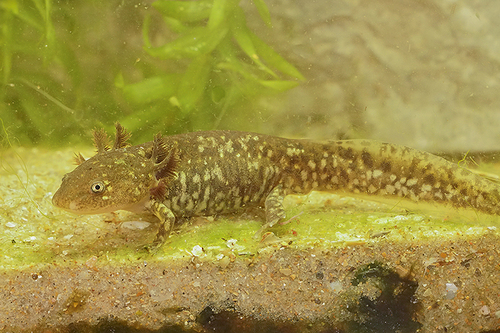
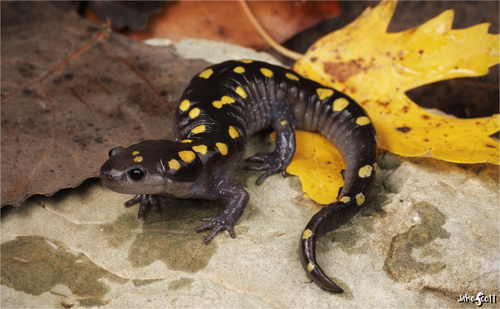
This species, the spotted salamander (scientific name Ambystoma maculatum (Shaw, 1802)), has an adult total length (including tail) of 15–25 cm (5.9–9.8 in), with females generally larger than males. Like most mole salamanders, it has a stout body and a wide snout. Its base body color is most often black, but can also appear as bluish-black, dark gray, dark green, or dark brown. Two uneven rows of yellowish-orange spots run from the top of the head near the eyes to the tip of the tail along the dorsolateral region. Spots on the upper head are more orange, while spots on the rest of the body are more yellow. The species' underside is colored slate gray and pink. Sexual dimorphism is present: larger females have brighter-colored spots, while males have a larger area of the dorsal surface covered by less bright spots. There is also a correlation between a salamander's body condition and lower chroma in its spots. The scientific name Ambystoma maculatum draws its meaning from Greek and Latin roots: Ambystoma combines the Greek amblys (blunt) and stoma (mouth); it can also come from New Latin anabystoma meaning "to cram into the mouth", while maculatum comes from Latin macula (spot) and maculosus (spotted). A. maculatum develops a larger tail fin and body to compete with other predators. The species typically lives around 20 years, with some individuals living up to 30 years. Spotted salamanders usually inhabit mature forests that contain ponds or ephemeral vernal pools used as breeding sites. Vernal pools are suitable breeding habitat because they dry frequently enough to exclude fish that eat salamander eggs and larvae, while holding water long enough for amphibian larvae to complete development and metamorphose into terrestrial adults. Research shows larger pools have more egg masses, higher population occupancy, and higher larval survival rates for spotted salamanders than smaller pools. Outside of the breeding season, spotted salamanders live in forests with well-drained soils that have many burrows dug by small mammals. They are typically absent from forest landscapes with canopy cover below 30%. Populations from nearby pools form genetically distinct metapopulations. Subpopulations located within 4.8 kilometers of each other share a higher proportion of genes, while populations separated by more than 4.8 kilometers share a smaller proportion of genes. Inter-population dispersal is likely influenced by both species-specific behaviors and natural limitations. For most of the year, spotted salamanders stay sheltered in leaf cover or burrows in deciduous forests. When temperatures rise and moisture levels are high, salamanders undertake an abrupt annual migration to their breeding ponds. Recent research indicates temperature may be a more important migration trigger than precipitation, as increased winter precipitation does not prompt migration. In a single night, hundreds to thousands of salamanders may travel to breeding ponds to mate. Males perform a circling courtship dance called a liebsspiel: they circle one another, rest their heads on each other's tails, then the male swims away while wiggling his tail, and deposits a spermatophore. If the female chooses to mate, she will follow the male to the spermatophore he created. Males migrate at higher rates than females early in the migration season, which may stem from differing temperature responses between the sexes. Mating typically occurs in ponds during spring rain events. Females usually lay around 100 eggs per clutch, which cling to underwater plants and form cohesive egg masses. These egg masses are round, jelly-like clumps that usually measure 6.4–10.2 cm (2.5–4 in) in length. Spotted salamanders have a unique polymorphism in the outer jelly layer of their egg masses: one morph is clear and contains a water-soluble protein, while the other morph is white and contains a crystalline hydrophobic protein. This polymorphism is thought to provide advantages in vernal pools with varying dissolved nutrient levels, and also reduces mortality from feeding by wood frog larvae. Adult spotted salamanders only remain in breeding water for a few days. Eggs hatch after one to two months, with hatching time dependent on water temperature. A. maculatum eggs can form a symbiotic relationship with the green alga Chlorococcum amblystomatis. The dense gelatinous matrix surrounding the eggs prevents desiccation, but it also inhibits oxygen diffusion that is required for embryo development. C. amblystomatis provides the embryo with increased oxygen and supplemental nutrition from fixed carbon products via photosynthesis, and removes the embryo's nitrogenous waste (ammonia) within the egg capsule, which supports embryonic development and growth. The developing salamander metabolizes the oxygen produced by the alga and produces carbon dioxide, which the alga in turn consumes. The presence of this photosynthetic alga within the egg capsule enhances the developing embryo's growth. However, the widely used herbicide atrazine has been found to significantly lower hatching success by eliminating the symbiotic algae associated with spotted salamander egg masses. Newly hatched larvae are usually light brown or greenish-yellow, with small dark spots, and are born with external gills. After two to four months, larvae lose their gills, become juvenile salamanders, and leave the water to move onto land. Spotted salamanders have been recorded living up to 32 years, and adults normally return to the same vernal pool for breeding every year. These seasonal pools usually dry out in late spring and remain dry until winter. Spotted salamanders are commonly preyed on by raccoons, skunks, turtles, snakes, and sometimes salmonoid fish, which means they perform an important role connecting the food chain. Humans also prey on this species, as they are popularly sought after in the pet trade.