About Ambystoma macrodactylum Baird, 1850
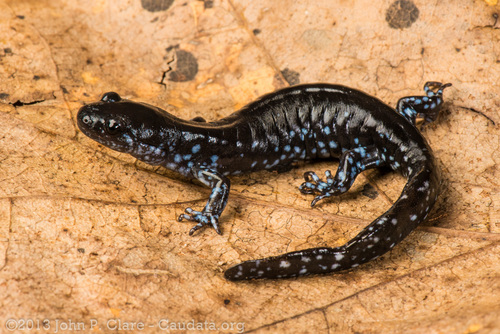
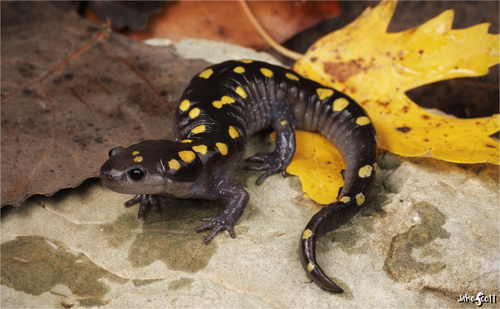
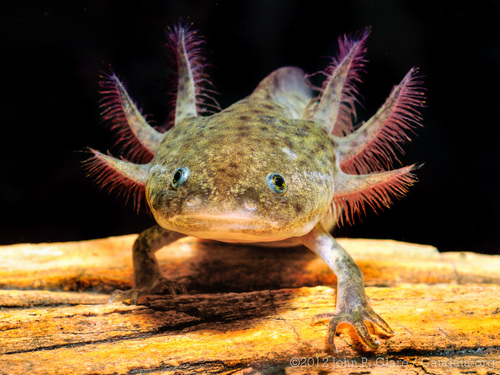
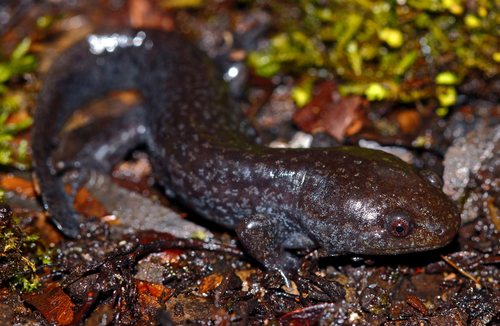
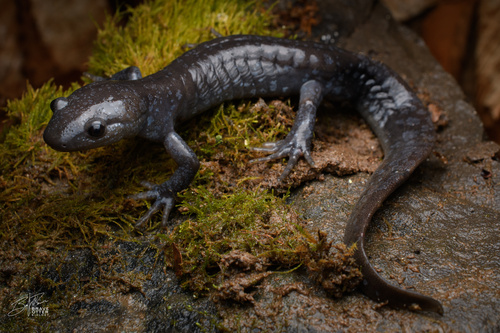
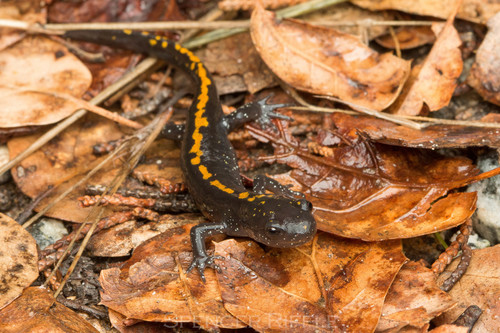
The long-toed salamander, with scientific name Ambystoma macrodactylum Baird, 1850, has a dusky black body with a dorsal stripe of tan, yellow, or olive-green, and this stripe may sometimes break into a series of spots. Its body sides can have fine white or pale blue flecks, while its belly is dark-brown or sooty with white flecks. Root tubercles are present, but are not as developed as in other species like the tiger salamander. The eggs of this species are similar to those of the related northwestern salamander (A. gracile) and tiger salamander (A. tigrinum). Like many amphibians, long-toed salamander eggs are surrounded by a transparent gelatinous capsule that lets the embryo be seen during development. Unlike A. gracile eggs, there is no visible green algae, which gives A. gracile egg jellies their green color. While still in the egg, the long-toed salamander embryo is darker on top and whiter below, while tiger salamander embryos are light brown to grey above and cream-colored on the bottom. Eggs are about 2 mm (0.08 in) or larger in diameter, with a wide outer jelly layer. Before hatching, both the egg stage and newborn larvae have balancers: thin skin protrusions that stick out from the sides to support the head. The balancers eventually fall off, and the external gills grow larger. After balancers are lost, larvae are distinguished by the sharply pointed flaring of the gills. As larvae mature and go through metamorphosis, their limbs with digits become visible, and the gills are resorbed. Larval skin is mottled with black, brown, and yellow pigmentation. Skin color changes as larvae develop, because pigment cells migrate and concentrate in different regions of the body. These pigment cells, called chromatophores, are derived from the neural crest. Salamanders have three types of pigment chromatophores: yellow xanthophores, black melanophores, and silvery iridiophores (or guanophores). As larvae mature, melanophores concentrate along the body to create the darker background. Yellow xanthophores arrange along the spine and on top of the limbs. The rest of the body is flecked with reflective iridiophores along the sides and underneath. As larvae metamorphose, digits develop from their protruding limb buds. A fully metamorphosed long-toed salamander has four digits on the front limbs and five digits on the rear limbs. Its head is longer than it is wide, and the long outer fourth toe on the hind limb of mature larvae and adults distinguishes this species from others. This toe is also the origin of its specific epithet macrodactylum, from Greek makros (long) and daktylos (toe). Adult skin has a dark brown, dark grey to black background, with a yellow, green, or dull red blotchy stripe, plus dots and spots along the sides. Underneath the limbs, head, and body, the salamander ranges from white to pinkish to brown, with larger white flecks and smaller yellow flecks. Adults are typically 3.8–7.6 cm (1.5–3.0 in) long. The long-toed salamander is an ecologically versatile species that lives in a variety of habitats, including temperate rainforests, coniferous forests, montane riparian areas, sagebrush plains, red fir forest, semiarid sagebrush, cheatgrass plains, and alpine meadows along the rocky shores of mountain lakes. Adults can be found in forest understory, hiding under coarse woody debris, rocks, and in small mammal burrows. During the spring breeding season, adults can be found under debris or in the shoreline shallows of rivers, streams, lakes, and ponds, and they often frequent ephemeral waters. This species is one of the most widely distributed salamanders in North America, second only to the tiger salamander. Its altitudinal range runs from sea level up to 2,800 meters (9,200 ft), spanning a wide variety of vegetational zones. Isolated endemic populations occur in Monterey Bay and Santa Cruz, California. The distribution reconnects in the northeastern Sierra Nevada, runs continuously along the Pacific Coast to Juneau, Alaska, with populations scattered along the Taku and Stikine River valleys. From the Pacific coast, the range extends eastward to the eastern foothills of the Rocky Mountains in Montana and Alberta.