About Ambystoma laterale Hallowell, 1856
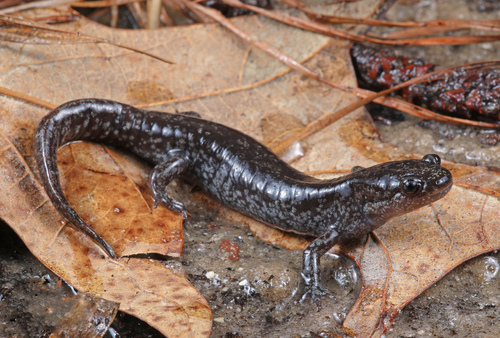
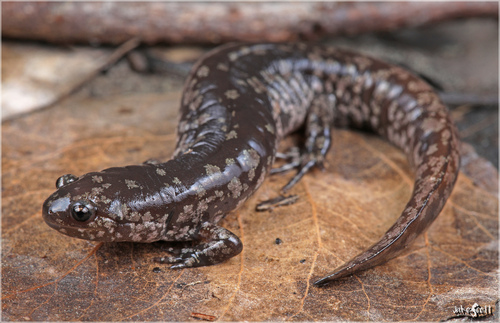
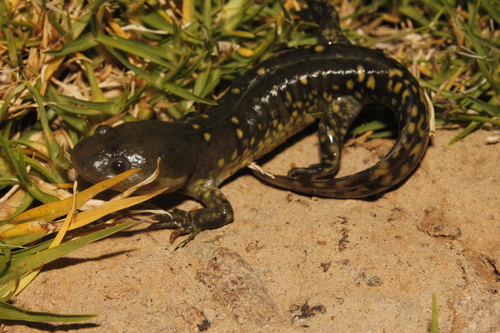
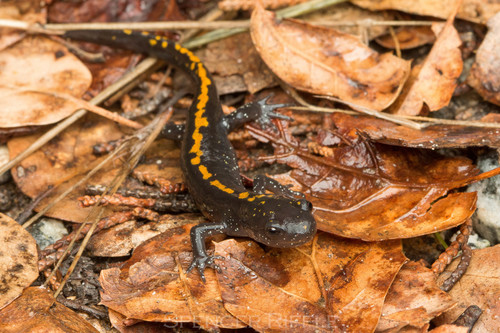
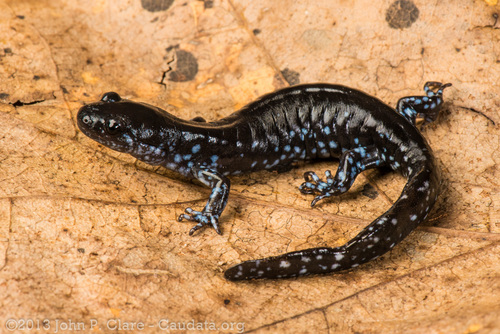
Blue-spotted salamanders (Ambystoma laterale Hallowell, 1856) measure between 10 and 14 cm (3.9 and 5.5 in) in total length, with the tail making up 40% of this length. Males are typically slightly smaller than females, but have longer, flattened tails. These salamanders have elongated bodies. Their skin is bluish-black, with characteristic blue and white flecks on the back, and bluish-white spots on the sides of the body and tail. The vent is typically black, which contrasts with the paler belly. Newly transformed individuals may have yellow splotches, which turn blue once the salamander becomes fully terrestrial. Occasional melanistic individuals can be found in the wild. They have long toes: four on each front foot, and five on each hind foot. Most specimens have 12–14 costal grooves. Blue-spotted salamanders are nocturnal: they stay underground during the day, and emerge at night to forage for food. This species includes unisexual lineages that can reproduce without fertilization via gynogenesis. Blue-spotted salamanders are native to northeastern North America. They are found as far west as the Great Lakes region of Michigan, United States, and north into the eastern provinces of Canada (Gilhen 1974). Large populations of this species exist in New England, USA, alongside many other salamander species. Blue-spotted salamanders are primarily found in moist, deciduous hardwood forests and swampy woodlands with sandy soil, though they may also occur in coniferous forests and fields. They prefer vernal pools that hold water into mid-summer, which provide suitable breeding habitat. This species is philopatric and largely dependent on the availability of ephemeral pools. Individuals commonly shelter under underbrush, leaf litter, rocks and logs. Emerging research indicates that habitat selection in this species may also be affected by factors including light pollution and chemical hues. Blue-spotted salamanders are currently experiencing habitat loss. Blue-spotted salamanders reproduce via spermatophores, which are sperm packets deposited by males. Males initiate reproduction by grasping the female and rubbing her head with his chin. To achieve fertilization, the female must be in close proximity to the deposited spermatophore, and males will position females to make this possible. Eggs are laid in small clusters attached to twigs, rocks or plants at the edge of woodland ponds or ditches. Clutches average around 12 eggs, and females can lay up to 500 eggs per year. Males and females reach sexual maturity and first mate at two years old. Breeding takes place in early spring near vernal pools. Eggs hatch after approximately one month. Upon hatching, larvae have well-developed mouths and eyes, plus external gills and broad tail fins. Front limbs develop at two weeks of age, and hind limbs develop at three weeks. Larvae remain fully aquatic until they transform into the terrestrial adult form. Aquatic larvae have neutral coloration, in shades of brown, green and gray, and their spots are yellow rather than blue (Gilhen 1974). Larvae complete their transformation to the terrestrial form by late summer. Blue-spotted salamanders are associated with ancient-origin unisexual (all-female) populations. These unisexual females often resemble blue-spotted salamanders, but carry hybrid genomes, and require sperm from a sympatric related salamander species to trigger egg development. In regions where Ambystoma laterale co-occurs with unisexual members of the Ambystoma complex, A. laterale males can provide sperm to support this reproduction via a system called kleptogenesis. In this system, hybrid females use received sperm to trigger egg development, and may sometimes incorporate the sperm's genetic material into their offspring. Most often, the sperm genome is discarded after triggering development and eggs develop asexually (this is gynogenesis, with premeiotic doubling). However, the sperm genome may be incorporated into the resulting offspring. Sperm genome incorporation usually occurs either as genome addition, which results in elevated ploidy in offspring, or genome replacement, where one maternal genome is discarded. This unique reproductive mode was named kleptogenesis by Bogart and his colleagues.