About Ambystoma jeffersonianum (Green, 1827)
The Jefferson salamander, with the scientific name Ambystoma jeffersonianum (Green, 1827), is a mole salamander native to the northeastern United States, southern and central Ontario, and southwestern Quebec. It was named after Jefferson College in Pennsylvania.
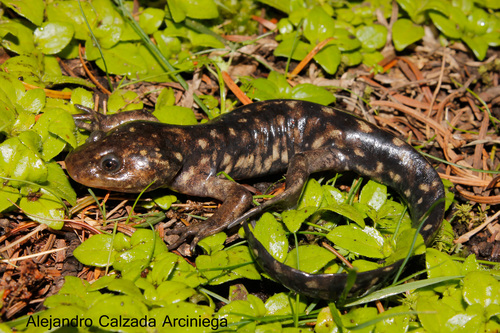
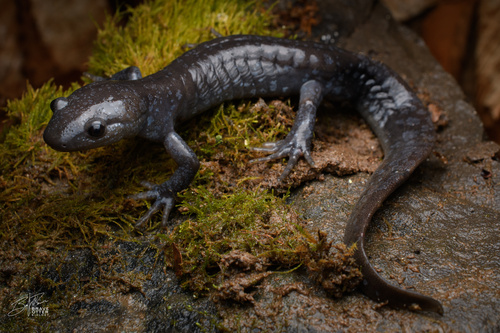
Its dorsal surface is typically dark gray, brown, or black, with a lighter shade on its anterior. Some individuals have silver or blue specks on their sides, and the area around the vent is usually gray. These salamanders are slender-bodied, with a wide nose and distinctive long toes. They range in size from 11 to 18 cm (4.3 to 7.1 in). Like other mole salamanders, the Jefferson salamander burrows, and has well-developed lungs adapted for this burrowing lifestyle. It is nocturnal by nature, but can be seen during the day in the mating season. Breeding takes place in early spring, after the area's snow has melted.
Secretive adult Jefferson salamanders usually hide under stones or logs, or in leaf litter and other underbrush in deciduous forests during damp conditions. They are generally not found in conifer forests, likely due to the dryness and prickly texture of some pine and spruce needles, which can injure amphibians with thin skins. For most of the year, during dry or freezing conditions, they burrow underground. To survive winter conditions in northern latitudes, they must dig below the frost line, which is about 18 inches deep. They often burrow in rich sandy soils found in upland deciduous forests, and sometimes in older-growth damp hemlock forests.
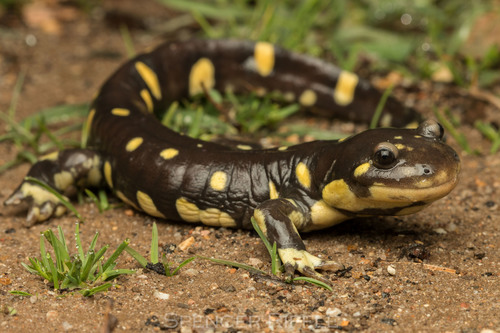
Since breeding sites are usually close to over-wintering burrows, migration to breeding areas is quick, and usually happens during or immediately after a heavy rainfall. They choose fishless ponds and vernal pools filled with spring snowmelt in northern latitudes as breeding sites. In fragmented landscapes, some breeding ponds can be hundreds of yards (meters) away from their forest home. At the northern edge of their range in southern Ontario, Jefferson salamanders are one of the first amphibians to emerge in spring. They have been observed "snowshoeing" across the still frozen forest understory to reach partially melted breeding ponds. Males migrate first, and females follow shortly after. These salamanders have small pores on their heads that exude a whitish liquid when handled, which suggests they may leave scent trails during migration. Ambystoma jeffersonianum is often found sharing habitat with the spotted salamander.
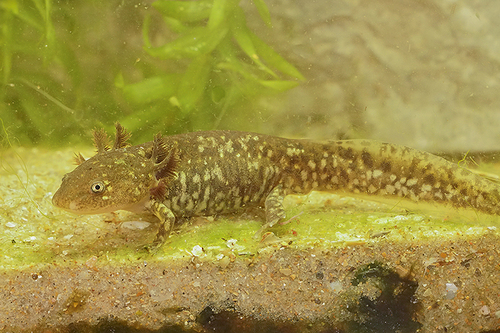
Eggs are laid in small clusters attached to submerged twigs or other natural supports at the edge of ponds. Egg clutches can contain between 5 and 60 eggs, with an average of about 30 eggs per clutch. The age when individuals first breed, and how often they breed, are currently unknown; it is estimated that females first breed at 22 months, and males at 34 months. Eggs develop rapidly, and can hatch within 15 days. Larvae remain in the pond for two to four months, and grow to between 3 and 8 times their hatching size during this period.
A unique reproductive pattern occurs in the Bluespotted-Jefferson Salamander Complex. Previously, it was thought that Jefferson salamanders and blue-spotted salamanders mated to produce hybrid silvery salamanders and Tremblay's salamanders, but it is now known that Jefferson salamanders do not breed with blue-spotted salamanders in laboratory settings. Genetic testing has confirmed that silvery salamanders and Tremblay's salamanders are polyploid females; only 2% of males survive, and all surviving males are sterile. Most of these polyploids carry two sets of chromosomes from the Jefferson salamander and one set from the blue-spotted salamander, resulting in an LJJ genotype, which is called a Tremblay's salamander.
This genotype forms when a polyploid female mates with a pure male Jefferson salamander. Often in warmer water conditions, the polyploid female incorporates the chromosome from the pure male Jefferson salamander into her egg, which usually has either an LJ diploid chromosome set or an LJJ triploid chromosome set, to produce LJJ or LJJJ offspring respectively. Often in cooler conditions, when an LJ or LJJ female mates with a Jefferson salamander male, she only "borrows" his sperm to trigger genetic cloning of herself, and does not add the male's J chromosome to the embryo's DNA. This same polyploid reproductive strategy is used by other mole salamander species. The presence of these polyploids makes it difficult to visually identify an individual's species, which skews population count measurements for both the Jefferson salamander and the blue-spotted salamander.
Jefferson salamander larvae are carnivorous, and typically eat aquatic invertebrates. Insufficient food supply can lead to cannibalistic behavior. Adult Jefferson salamanders are also carnivorous, and eat a variety of small invertebrates.