About Ambystoma californiense Gray, 1853
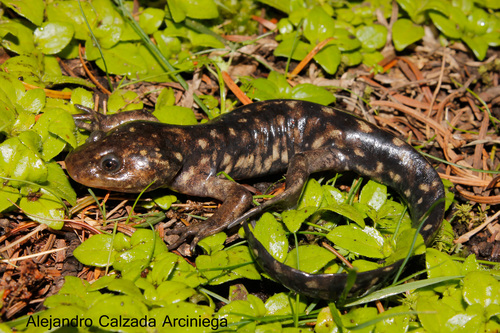
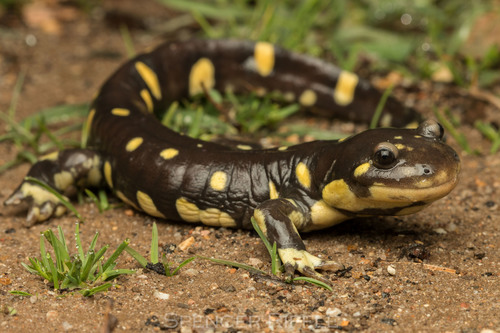
The California tiger salamander (Ambystoma californiense Gray, 1853) is a relatively large, secretive amphibian endemic to California. Adult individuals reach a total length of around 7 to 8 inches, with a stocky body and a broad, rounded snout. Adults have black bodies marked with yellow or cream spots, while larvae are greenish-grey. This species has brown protruding eyes with black irises.
For reproduction, the California tiger salamander depends on vernal pools, other seasonal ponds, and stock ponds; its habitat is restricted to the area around large, fishless vernal pools or similar water bodies. It occurs at elevations up to 1000 m (3200 ft). At the start of the first major rainfall of fall and winter, adults migrate at night from upland habitats to aquatic breeding sites, then return to upland habitats after breeding. This migration leaves them vulnerable to negative impacts from human development, such as road mortalities. Historically, the California tiger salamander likely occupied grassland habitats across much of California. Its current range extends from Sonoma County (especially in the Laguna de Santa Rosa outside the floodplain) south to Santa Barbara County, and also includes vernal pool complexes and isolated ponds along the Central Valley from Colusa County to Kern County, plus the coastal range. The Santa Barbara and Sonoma populations have been listed as endangered since 2000 and 2003, respectively. On August 4, 2004, the US Fish and Wildlife Service listed the California tiger salamander as threatened within the Central Distinct Population Segment, with the listing effective September 3, 2004. This action reaffirmed the existing endangered listings for the other distinct population segments and extended protection to all remaining populations. Six distinct populations are recognized: in Sonoma County, the Bay Area (Stanislaus County, western Merced County, and most of San Benito County), the Central Valley, the southern San Joaquin Valley, the Central Coast Range, and Santa Barbara County.
The primary causes of California tiger salamander population loss are human destruction of habitat, loss of access to breeding habitats, and introduced predators such as American bullfrogs. A viable hybrid form exists between the California tiger salamander and the introduced barred tiger salamander (Ambystoma tigrinum mavortium); genetic evidence indicates these two taxa have hybridized for 50 to 60 years. Hybridization between a threatened native species and an invasive species complicates conservation protection efforts for the California tiger salamander.
Adults spend most of their lives underground, in burrows created by other animals such as ground squirrels and gophers, as this species is poorly adapted for digging its own burrows. Little is known about their underground activity. This underground period has often been called estivation, the summertime equivalent of hibernation, but true estivation has never been observed in the species. Fiber optic cameras placed in burrows have allowed researchers to observe salamanders actively foraging underground. Adults are documented to eat earthworms, snails, insects, fish, and even small mammals, though adult California tiger salamanders eat very little overall.
Breeding occurs after the first rains in late fall and early winter, when the wet season allows salamanders to migrate to the nearest pond. This journey can be as far as 1.3 miles and take several days. Females lay eggs in small clusters or singly, and eggs hatch after 10 to 14 days. The larval period typically lasts three to six months, but California tiger salamander larvae may also overwinter in the aquatic environment. Transformation for overwintering larvae can take 13 months or more. Recent discoveries of overwintering have important management implications for this threatened species, particularly when aquatic habitats are modified. Larvae feed on other small invertebrates, including tadpoles. When their breeding pond dries, larvae resorb their gills, develop lungs, and then newly transformed juveniles (metamorphs) leave the pond to search for a burrow.
Morphology of California tiger salamanders becomes adult-like soon after hatching, and full metamorphosis is usually completed within a few days. One study recorded transformation in as few as four days. This rapid metamorphosis is advantageous for breeding in ephemeral ponds, as salamanders must be ready to leave the pond before it dries out, and is likely an evolutionary adaptation to the species' unpredictable climate and variable local site conditions. The range of the California tiger salamander often experiences multi-year periodic droughts. Juvenile recruitment (the number of new juveniles added to a population) is minimal during these drought periods, but the species is sustained by occasional years with very high recruitment. These alternating periods of high and low recruitment are called "boom and bust" cycles.
While some eggs may be laid in pools that dry too early during drought, environmental signals can stop California tiger salamanders from traveling to breeding pools in the first place. These cues for breeding migration are an additional mechanism that drives the species' boom and bust population cycles. Amphibian breeding migrations only happen when there is a high probability the breeding pond will hold enough water, so adequate precipitation is an important factor.
Female California tiger salamanders appear less sensitive to the environmental cues that trigger breeding migrations than males. Males have been observed to arrive at breeding pools first and stay longer than females, which gives them more opportunities to mate with a greater number of females. Females increase their chance of reproductive success by waiting for a longer period of favorable environmental conditions before migrating. This delay likely reduces the risk of danger during their terrestrial migration to the breeding pool and may also give them access to a larger number of potential mates. Some females do not migrate at all if environmental conditions are unsuitable. Females invest more energy into offspring than males, so they have more to lose if the pond dries early and prevents juvenile metamorphosis. Yearly variation in the number of breeding females therefore corresponds to differences in annual precipitation. According to recorded data, "the average female bred 1.4 times and produced 8.5 young that survived to metamorphosis per reproductive event, resulting in roughly 12 lifetime metamorphic offspring per female." California tiger salamanders can live up to 15 years.