About Ambystoma annulatum Cope, 1886
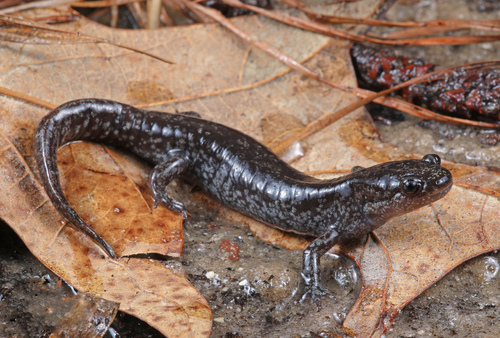
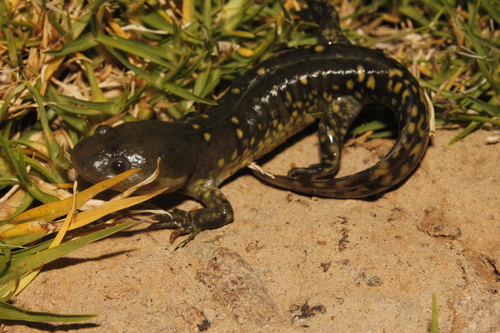
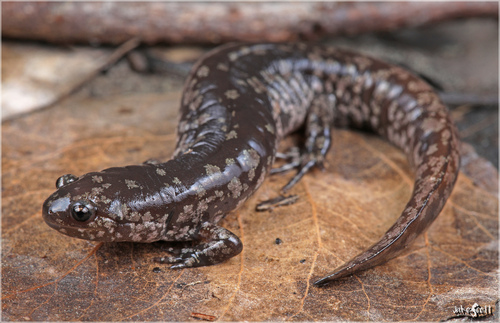
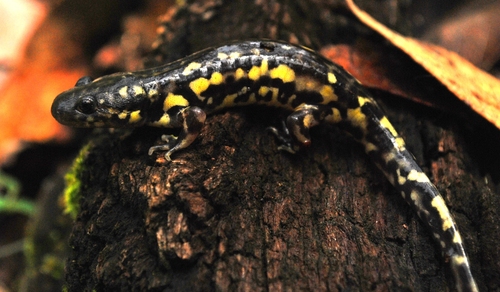
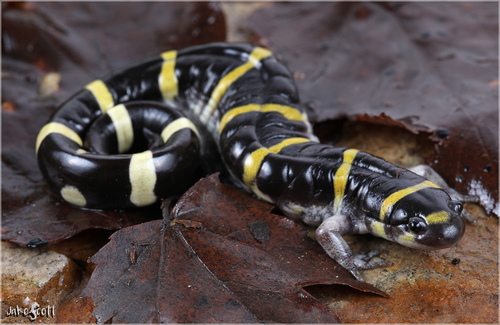
The ringed salamander, scientifically named Ambystoma annulatum Cope, 1886, has a slender body, small head, and long tail. This species has 15 costal grooves (grooves running along the rib region) and a flattened, rounded snout. It has two rows of vomerine teeth—teeth located on a thin bone that forms the lower and back portion of the nasal septum, which divides the nostrils. Each tooth row holds between 7 and 11 teeth. Each of the species' hind feet has five toes. Adult dorsal (back) coloration ranges from dark gray to blackish brown, patterned with white to yellowish bands and pale dots. The ventral (belly) side is usually grayish-yellow. Newly metamorphosed juvenile ringed salamanders have black backs, white bellies, and a row of pale spots running from the forelimbs to the tail. Yellow bands begin to develop soon after metamorphosis, and full adult coloration is formed within two months of metamorphosis.
The ringed salamander is a fully terrestrial species, found in hardwood forests and mixed hardwood-pine forests. Outside of the breeding season, adult ringed salamanders hide under leaf litter, rotting logs, or abandoned ground holes in damp forest areas. Larvae and juveniles live in small, fishless, semi-permanent ponds. Most ringed salamanders occur near Hot Springs, Arkansas, and the Missouri section of the Ozark Plateau, with small populations also found in eastern Oklahoma. This species is endemic to the Ozark Plateau and the Ouachita Mountains of southern Missouri, Arkansas, and eastern Oklahoma. It has a far more restricted geographic range than other species in the same genus, such as Ambystoma maculatum and Ambystoma opacum.
Habitat loss and related changes impact the ringed salamander in specific ways. While late summer pond drying has strong negative effects on spring-breeding species like the spotted salamander, it has little impact on the ringed salamander. However, reduced rainfall and fewer filled ponds during September and October can cause a large drop in the ringed salamander's breeding activity and egg laying. Average canopy cover and leaf litter depth do not have a significant connection to whether the species occupies a site, but continuous forest cover is strongly associated with the breeding wetlands the species uses. Clear-cut timber harvesting has a negative effect on the species' distribution. Forest sites after clear-cutting have more open canopies, which leads to higher ground temperatures. To survive, ringed salamanders either retreat underground into burrows or move to other locations. Small-bodied juveniles and adults are more vulnerable to these changes, as they have lower dispersal abilities.