About Amblyteles armatorius (Forster, 1771)
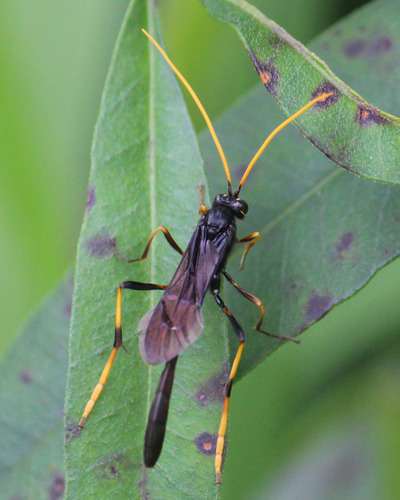
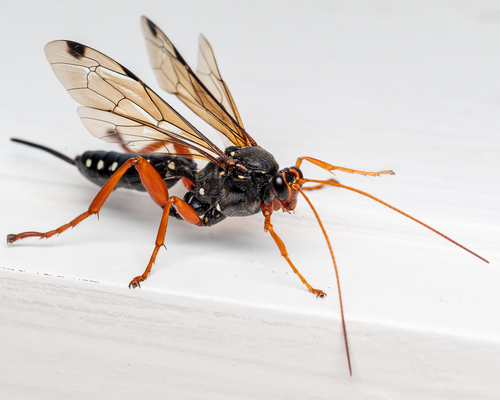
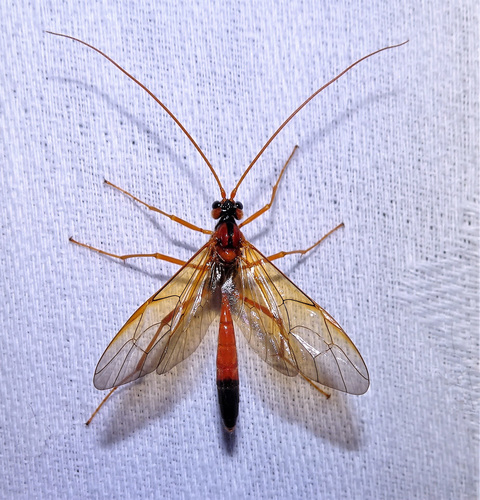
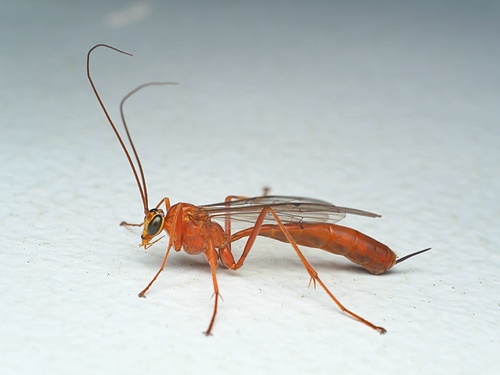
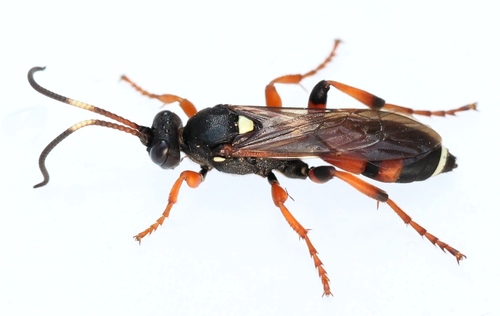
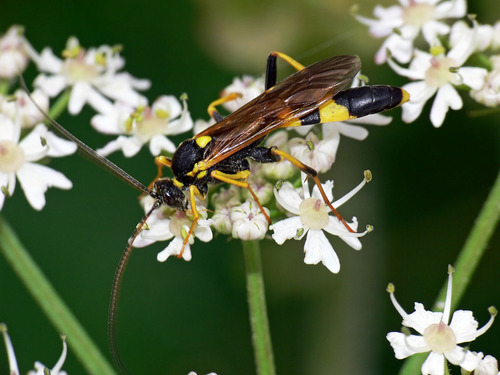
Amblyteles armatorius reaches a body length of 12–16 mm, not including its antennae, which measure approximately 9 millimeters (0.35 in). This large wasp has a black head and thorax, with the only exception being its yellow scutellum. The abdomen is yellow, and is more oval-shaped in female individuals, and marked with broad black bands. The legs are yellow, apart from the hind legs, which are a mixture of black and yellow. This species does not have a sting, so its characteristic markings that match many aculeate wasps function as protective mimicry. Females have a very short ovipositor that does not protrude from the abdomen. Adult Amblyteles armatorius are typically found in summer on flowers, especially species in the Apiaceae family, where they feed on nectar and pollen. Adults of this species overwinter. As a parasitic wasp, females lay their eggs inside moth caterpillars. After hatching, the larvae feed on their host caterpillars, which come mainly from the families Noctuidae and Notodontidae, but also include some species from Geometridae, Erebidae, Saturniidae, and Lasiocampidae, specifically Calliteara pudibunda, Odontopera bidentata, Macrothylacia rubi, and Saturnia pavonia. Amblyteles armatorius is a Palearctic species that occurs across most of Europe, as well as in the Near East and the Oriental realm. These wasps most commonly live in hedgerows, meadows, and spruce forest edges.