About Amblyramphus holosericeus (Scopoli, 1786)
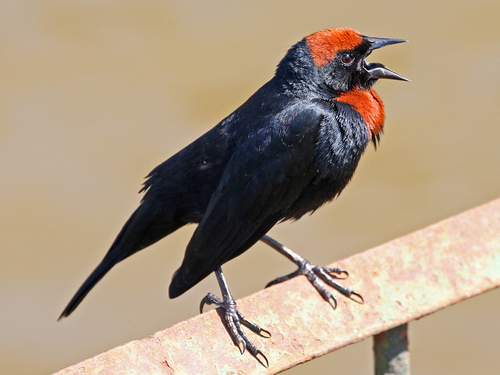
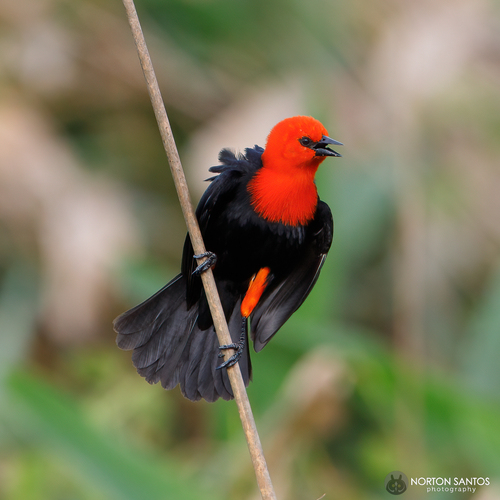
This species, the scarlet-headed blackbird, reaches approximately 24 centimeters in total length. It has a distinctively shaped bill that is long, slender, very sharp, and appears almost upturned. Adult individuals of both sexes match the species' common name with their scarlet head plumage. Juveniles have fully black plumage; orange-red feathers first emerge on the breast and throat, and later spread to the neck, head, and thighs. The scarlet-headed blackbird's song is loud, clear, and melodic, consisting of a ringing sequence transcribed as 'cleer-cleer-clur, clulululu'. Its calls are simpler but share the same clear, melodic quality as the song. Scarlet-headed blackbirds live in pairs within large reed beds across Argentina, Paraguay, Uruguay, and southern Brazil. Bolivia hosts an isolated population of the species that resides at an altitude of approximately 600 meters. These birds often perch visibly on the tops of reed stems. They are an uncommon species, particularly in areas located further inland from the coast. Their diet consists mainly of fruit, with seeds and invertebrates (especially insects) eaten as supplementary food. They use their specially shaped bill like a hammer to open food items. Scarlet-headed blackbirds are monogamous, and their individual breeding territories are clustered together in groups. They build an open cup-shaped nest, placed in the crotch of a shrub or woven into existing vegetation. Females lay a clutch of two eggs per nest.