About Amblyptilia falcatalis (Walker, 1864)
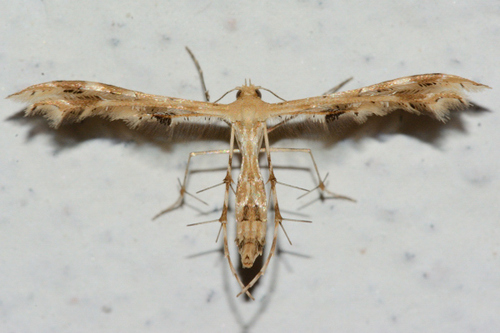
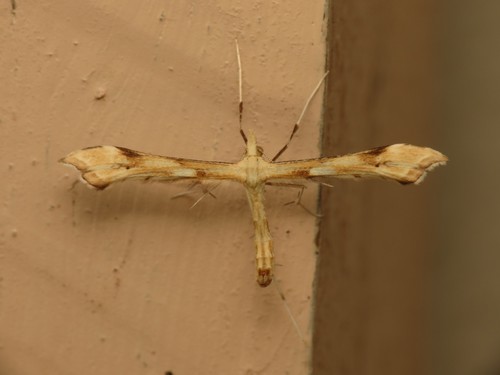
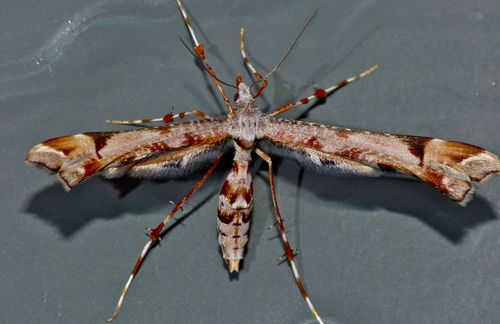
The scientific name of this species is Amblyptilia falcatalis (Walker, 1864). In 1939, Hudson discussed and illustrated the larva of this species, and provided the following description: The larva, which feeds inside the opening leaf and flower buds of Hebe salicifolia, is about 1 inch in length, fairly stout, slightly tapering at each end, with well-defined segments. Its head is small, greenish, and mottled with brown; the second segment has an obscure ochreous dorsal plate. The rest of the body is yellowish-green, darker on the sides and under-surface. A broad, slightly irregular deep red dorsal line runs from segment 3 to the anal extremity, and there are several slightly darker green subdorsal lines. The warts are minute, and emit short slender blackish bristles. Full-grown larvae can be found at the end of October and the end of February, so there are most likely two complete broods per season. Hudson discussed the larva of this species again in 1950, and illustrated both the larva and the pupa. When describing the specimen he used as the basis for his 1950 work, Hudson noted that the green subdorsal lines he described in 1939 were replaced by faint, broken reddish lines. He also stated that larvae of A. falcatalis have black legs, a trait that appears to be characteristic for the species. Hudson also provided a description of the pupa: The pupa is slightly under 1⁄2 inch (11 mm) long. In form, it is very similar to the pupa of P. aeolodes; its dorsal appendages are slightly shorter and flatter, with a small spine projecting from the extremity of each. Its general colour is rather dull reddish-brown, a little paler on the ventral surface, and faintly mottled with darker brown. It has an obscure paler lateral line, and the abdomen has four rows of conspicuous whitish warts. The pupa is suspended by its tail, with the ventral surface pressed against its supporting object. Walker originally described the adult male of the species as follows: Male. Ferruginous. Tibiae and tarsi ferruginous, with two whitish bands on each. Fore wings falcate, speckled with cinereous; a triangular black costal spot beyond two-thirds of the length, attenuated towards the disk; a pale lawn-coloured costal spot adjoining the outer side of the black spot, including a black longitudinal streak, another black streak behind the first, partly bordered by an acute angle, which is formed by the submarginal transverse whitish line; three elongated irregular blackish marks along the interior border. Length of the body 6 — 7 lines; of the wings 12—14 lines. Adult moths of this species are very similar in appearance to A. repletalis. However, compared to P. carduidactyla, A. falcatalis has a more rectangular, parallel-edged second lobe of the forewing. This species is endemic to New Zealand, and is found in both the North and South Islands.