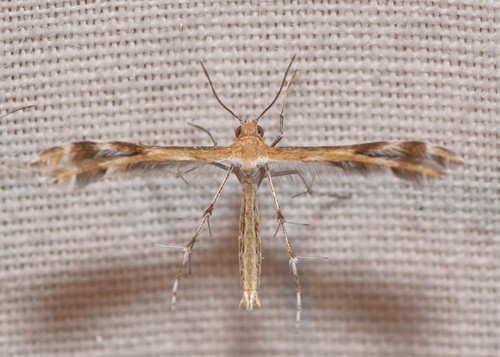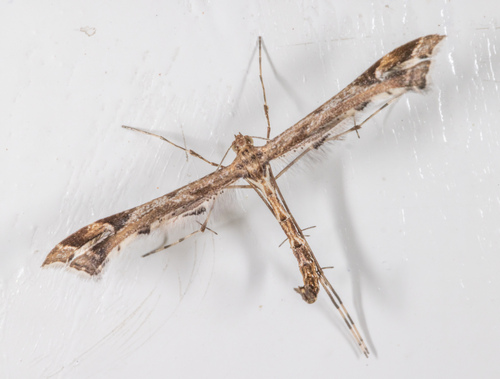
About Amblyptilia acanthadactyla (Hübner, 1813)
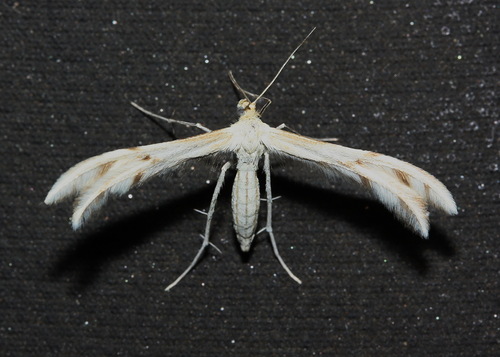
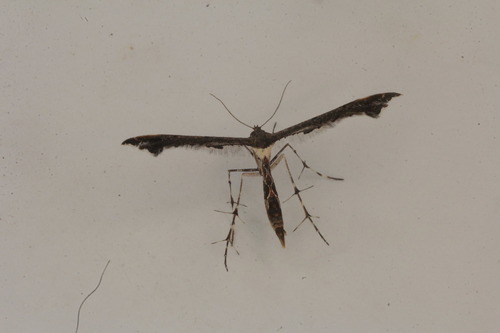
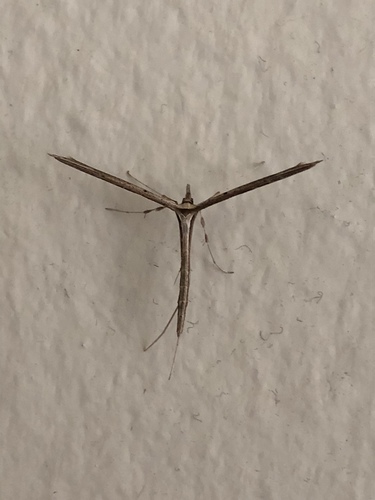
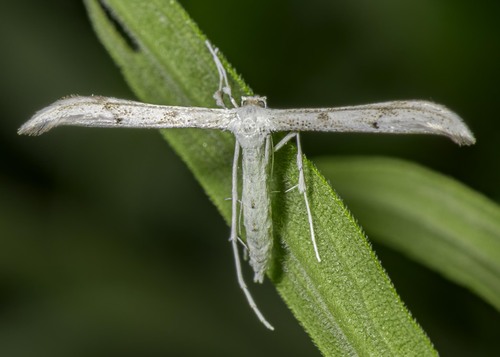
This species, commonly known as the beautiful plume moth, has a wingspan ranging from 17 to 23 millimetres, or 0.67 to 0.91 inches. The adult beautiful plume moth resembles the closely related brindled plume moth (Amblyptilia punctidactyla) in overall appearance, but can be distinguished by its warm reddish-brown coloration. In contrast, the brindled plume moth is a darker greyish-brown and has distinct white speckling. Certain identification requires examination of the species' genitalia. The moth can be in flight almost year-round, producing two generations per year: one flies in July, and the second flies from September through June, overwintering as an adult. Moths become active at dusk, and autumn generation individuals have been found on ivy (Hedera helix). Larvae feed on a variety of low-growing plant species, including restharrow (Ononis spp.), hedge woundwort (Stachys sylvatica), wild cranesbills (Geranium species), cultivated geraniums (Pelargonium species), goosefoots (Chenopodium species), heathers (Calluna and Erica species), mints (Mentha species), sage (Salvia), wood sage (Teucrium scorodonia), lavender (Lavandula species), eyebright (Euphrasia species), carline thistles (Carlina species), Vaccinium species, calamints (Calamintha species), and catnip (Nepeta species). The beautiful plume moth is found in Europe, and is also recorded from Iran and Georgia.