About Amblypodia anita Hewitson, 1862
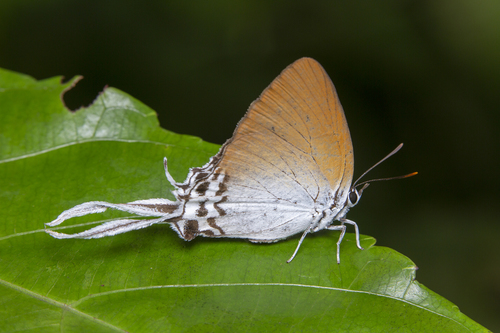
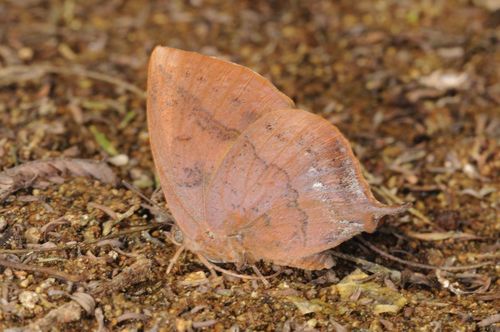
Male: Upperside is dark violet-purple with very little gloss, and this colour obscures the black marginal borders. On the forewing, the costa and outer margin have a moderately broad blackish band, which is generally broadest on the outer margin. On the hindwing, the costal band is broad and the outer marginal band is narrow, appearing as just a thin line in most specimens; the anal lobe is marked with dull red. Cilia are black; the tail is stout, and has black cilia. Underside is rufous-brown. The forewing has a black line running from the costa near the apex to the hinder margin beyond the middle, which is followed by a post-discal series of faint, disconnected, lunular black marks that are not always present. Indistinct markings of a sub-marginal series are sometimes visible as well. The hindwing has a medial outwardly curved black line and an indistinct outwardly curved discal series of black dots marked with white points; both of these features are continuations of the two lines on the forewing. There is also a sub-marginal series of similar black dots, and the base tone of the wing varies between different specimens. Female: Upperside is very dull violet, and sometimes nearly violet-brown. The forewing has broad blackish-brown borders along the costa and outer margin. The hindwing is generally a uniform dull violet-brown with no borders, and its anal lobe matches that of the male. The underside varies in shade from ochreous-grey to violet-brown, and its markings match those of the male. However, some darker-coloured female specimens have a band of diffused whitish marks connected to the discal line. Antennae are black with an orange tip; the head and body, both above and below, match the colour of the wings.