About Amblyomma americanum Linnaeus, 1758
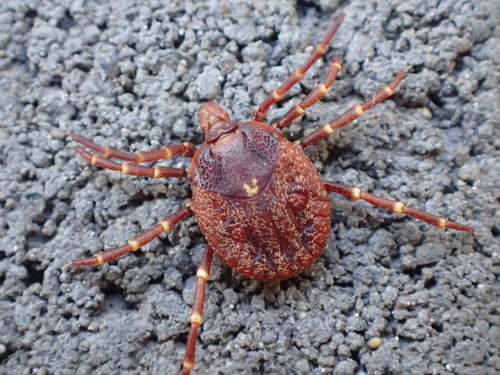
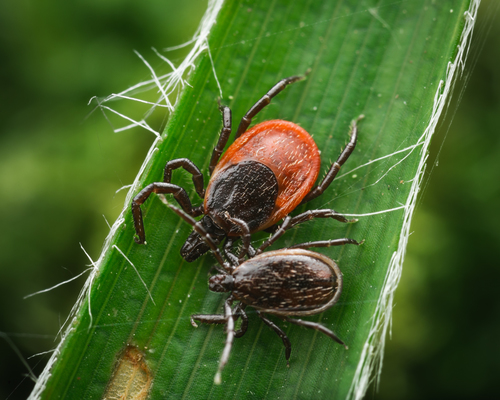
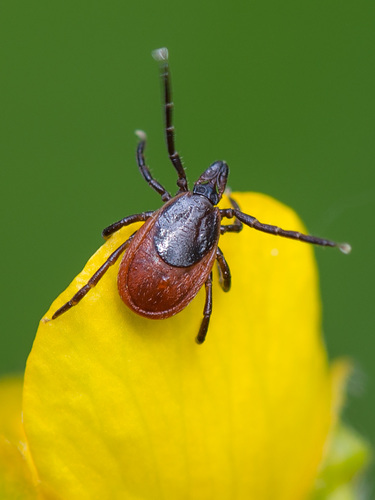
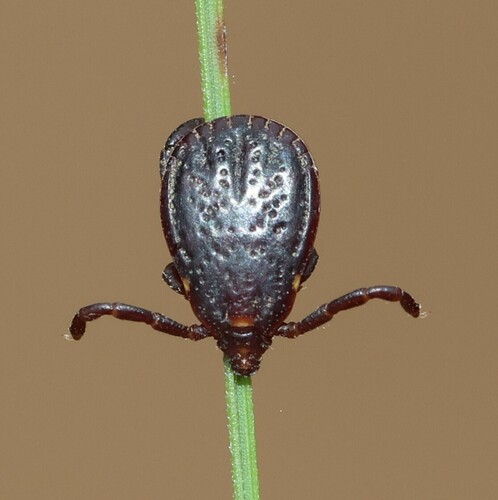
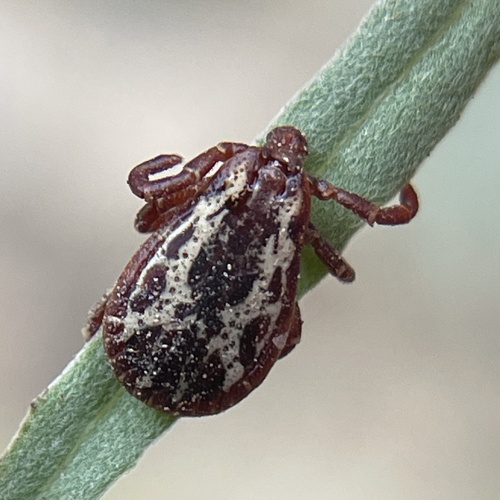
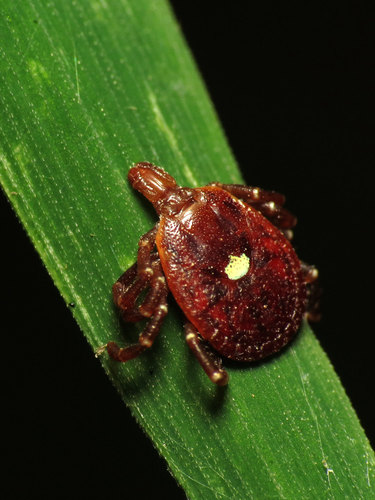
Amblyomma americanum, commonly known as the lone star tick, northeastern water tick, turkey tick, and cricker tick, is a tick species indigenous to much of the eastern United States and Mexico. Its bites are painless and commonly go unnoticed. Once attached to a host, it can remain attached for up to seven days until it is fully engorged with blood. It bites aggressively, and its larvae can transfer to human skin from discarded clothing that is put back on. Adult lone star ticks are sexually dimorphic. The adult female has a silvery-white, somewhat star-shaped spot near the center of the posterior portion of its dorsal shield (called the scutum). Adult males, by contrast, have varied white streaks or spots around the margins of their shields. The common name 'lone star tick' refers to this distinctive spot, not the state of Texas. The common name 'turkey tick' comes from wild turkeys, which are a common host for the tick's immature stages in some Midwestern U.S. states. This tick is the primary vector of Ehrlichia chaffeensis, which causes human monocytic ehrlichiosis, and Ehrlichia ewingii, which causes human and canine granulocytic ehrlichiosis. Bites from this tick can also trigger alpha-gal syndrome in humans, an allergy to non-catarrhine mammalian meat. Other disease-causing bacterial agents isolated from lone star ticks include Francisella tularensis, Rickettsia amblyommii, and Coxiella burnetti. The lone star tick is widely distributed across the eastern, southeastern, and Midwestern United States. It inhabits wooded areas, particularly second-growth forests with thick underbrush, where white-tailed deer—the primary host of mature ticks—reside. It can also be found in ecotonal areas, which are transition zones between different biomes, such as zones between forest and grassland ecosystems. The tick uses thick underbrush or high grass to attach to hosts through a behavior called questing: it climbs up a blade of grass or to the edges of leaves, stretches its front legs forward, and in response to stimuli from biochemicals like carbon dioxide, heat, and vibration from movement, it climbs onto a passing host when the host brushes against the tick's legs. Once attached to the host, the tick moves around to select a preferred feeding site. The tick has also been reported outside of its native range in Canada, in areas of Southern Ontario including London, Wellington County, and the Region of Waterloo.