About Amblycirrhitus pinos (Mowbray, 1927)
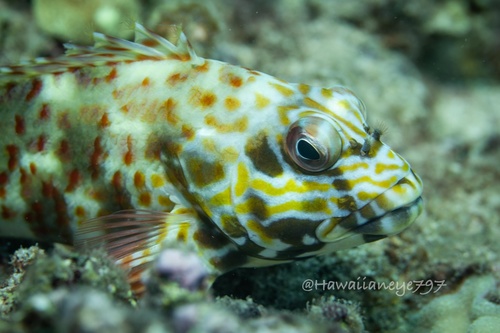
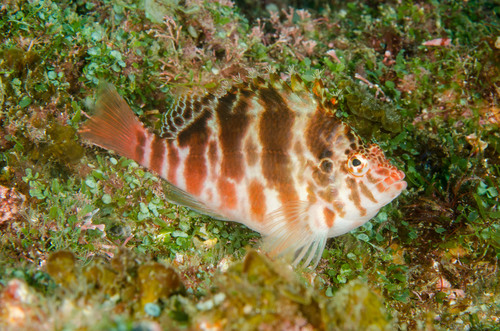
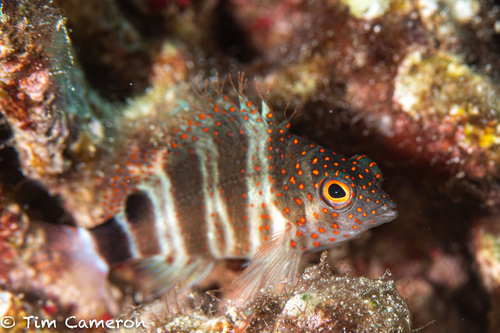
Amblycirrhitus pinos, commonly known as the redspotted hawkfish, has an oval, moderately compressed body with a short, sharp snout. A fringe of cirri sits on the posterior margin of its anterior nostril. It has a moderately large mouth, with a row of small canine-like teeth along the outer edges of the jaws and a band of simple teeth inside this outer row. Teeth are also present on the middle and sides of the roof of its mouth. The gill cover bears a pair of flattened spines, and the preoperculum has fine serrations. Its dorsal fin is continuous, with only a small incision between the spiny section and the soft-rayed section. The dorsal fin has 10 spines and 11 soft rays, while the anal fin has 3 spines and 8 soft rays. The membranes between the dorsal fin spines are deeply notched, and each spine has a tuft of cirri at its tip. The caudal fin is truncate. The lower part of the pectoral fin has 5 to 7 robust rays, with deeply incised membranes between them, and these rays are noticeably longer than the other pectoral fin rays. The pelvic fin has one spine and 5 soft rays, and its origin is positioned behind the base of the pectoral fin. This species reaches a maximum standard length of 9.5 cm (3.7 in). Its body has an overall whitish background color, with multiple brownish vertical bands on the back and flanks, a dark brown caudal peduncle, and numerous red spots across the head and the adjacent portion of the body. This species is found in the western Atlantic Ocean, at depths shallower than 46 m (151 ft). It is common in rocky areas and rubble habitats, and frequently lives in crevices and small caves. Its known range includes Bermuda, the Bahamas, the Florida Keys, Cedar Key off Florida, the Flower Garden Banks and the surrounding region in the Gulf of Mexico; the area extending from Tuxpan, Mexico along the northern coast of the Yucatan Peninsula to northwestern Cuba. It also occurs throughout the Caribbean, including at Isla de Aves. To the south, it can be found along the South American coast as far south as Rio de Janeiro, Brazil, and also at Trindade Island.