About Amblycercus holosericeus (Deppe, 1830)
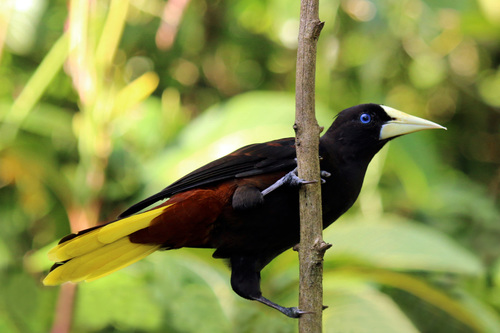
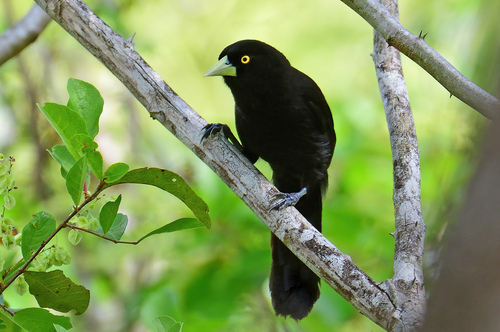
The yellow-billed cacique, with the scientific name Amblycercus holosericeus, is a cacique species in the Icteridae family. It is the only member of the monotypic genus Amblycercus, and there is ongoing scientific debate over whether it qualifies as a true cacique. This bird has entirely black plumage, dark gray legs and feet, yellow or yellow-orange eyes, and a yellow bill with a gray tinge. It reaches a length of 23 cm (9.1 in). Its known distribution spans Belize, Bolivia, Colombia, Costa Rica, Ecuador, El Salvador, Guatemala, Honduras, Mexico, Nicaragua, Panama, Peru, and Venezuela. Three subspecies are currently recognized: the nominate subspecies A. h. holosericeus, first described by Deppe in 1830, which ranges from southeastern Mexico to northwestern Colombia; A. h. flavirostris, described by Chapman in 1915, found from western Colombia to northern Peru; and A. h. australis, described by Chapman in 1919, which occurs from northern Colombia and northwestern Venezuela to eastern Peru and northern Bolivia. Its natural habitats are subtropical or tropical moist lowland forests, subtropical or tropical moist montane forests, and heavily degraded former forest. The yellow-billed cacique’s diet consists of insects, other invertebrates, and some fruit. It uses a woodpecker-like pecking technique to reach food inside branches and bamboo. In some regions, this species is a specialized bamboo feeder, while in others it feeds from a wide range of different vegetation types. Unlike most other members of its family, which typically build hanging woven nests, the yellow-billed cacique constructs a sturdy cup-shaped nest in spring.