About Ambloplites rupestris (Rafinesque, 1817)
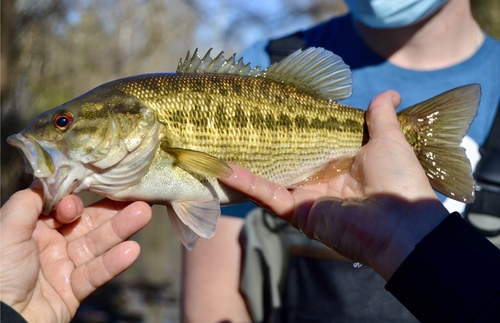
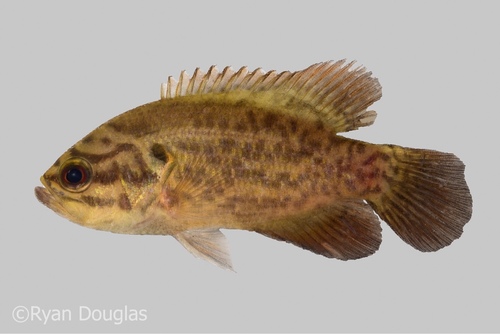
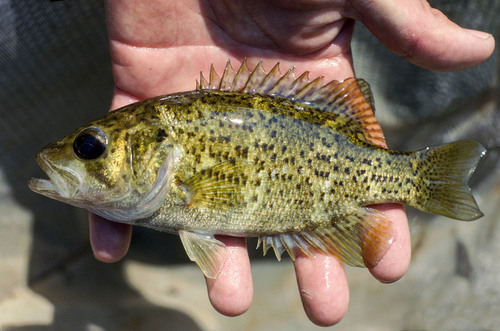
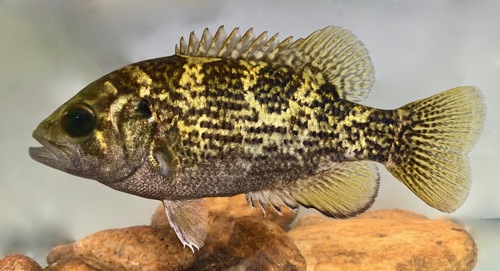
Ambloplites rupestris, commonly called rock bass, are similar in appearance to smallmouth bass, but are usually quite a bit smaller. Key identifying characteristics of rock bass include two united dorsal fins made of separate spinous and soft-rayed portions, a large mouth, six anal spines, red eyes, and rows of dark dots on their sides. Their large mouth is positioned terminally, below the snout, and lined with small conical teeth for catching and eating prey. The average adult rock bass measures between 6 and 10 inches (150 and 250 mm), and individuals rarely weigh more than one pound. Few rock bass live longer than 10 to 12 years. A. rupestris is the largest and most common species in the Ambloplites genus, with a maximum recorded length of 43 cm (17 in) and a maximum recorded weight of 1.4 kg (3.1 lb); the maximum recorded lifespan for the species is 10 years. Rock bass have body coloration that ranges from golden brown to olive, with a white to silver belly, and they can rapidly change their color to match their surroundings. This chameleon-like trait allows them to thrive throughout their wide range. Rock bass are native to North America. Their native range includes the St. Lawrence River and Great Lakes system, and the upper and middle Mississippi River basin, extending from Québec and Saskatchewan in the north down to Missouri and Arkansas, as far south as the Savannah River. Their native range also covers the eastern United States from New York through Kentucky and Tennessee to the northern parts of Alabama, Georgia, and Florida in the south. Rock bass have also been found in the Nueces River system in Texas. A population of rock bass introduced to the Loire River in France between 1904 and 1910 remains successfully self-sustaining more than 100 years later, but is not expanding invasively. Rock bass prefer clear, rocky, vegetated stream pools and lake margins. Rocky banks of northeastern lakes and reservoirs are common habitats for this species. Their preferred habitat includes some vegetation, rocky bottoms, and cool to warm water. Rock bass are typically found near rocky shorelines. They are often surprisingly unbothered by human activity, and regularly live under lakeside docks and near swimming areas. Rock bass are frequently found in groups, particularly near other sunfish. Rock bass reach sexual maturity at around two to three years of age. They are polygynandrous, meaning both females and males have multiple mates during a single breeding season. Spawning takes place from April to early June, in warm water between 12–15 °C (54–59 °F). Females lay between 2,000 and 11,000 eggs per spawn. Like other members of the sunfish family, male rock bass dig a nest in shallow lake areas, and aggressively guard the nest. A single spawning area may be heavily used, with many rock bass nests built very close together. This proximity causes males to become quite aggressive as they work to defend territory, and attract and retain mates. Rock bass do not perform courtship displays. Instead, a female enters the male’s nest and joins the male in his circular movement, and both individuals release sperm and eggs into the nest at the same time. The male guards and fans the eggs, and later cares for the newly hatched young for a short time. Rock bass are known to grow quickly.