About Ambloplites ariommus Viosca, 1936
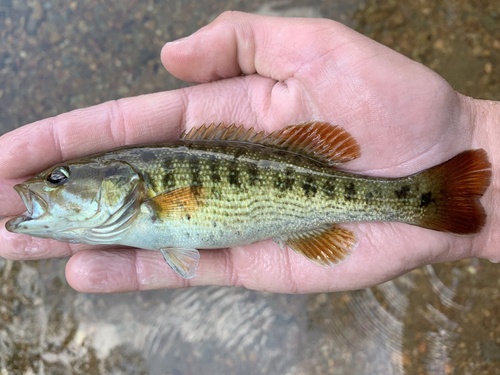
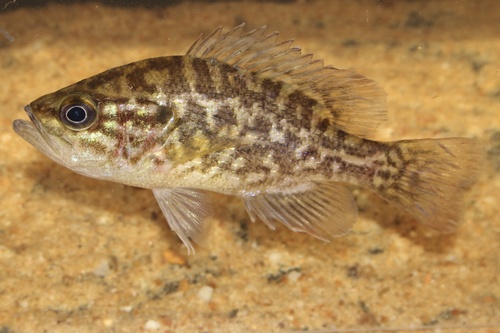
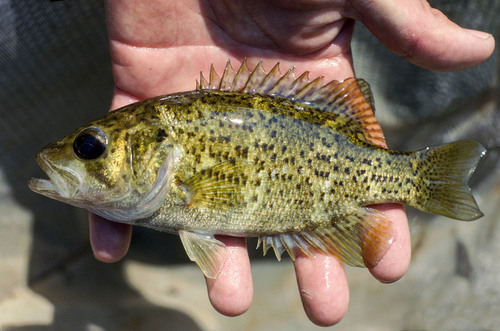
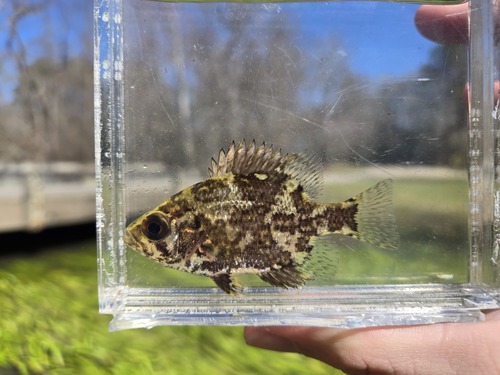
Ambloplites ariommus, commonly called the shadow bass, has a lateral line made up of 36 to 42 scales. Its dorsal fin has 11 spines and 11 to 12 soft rays, while its anal fin has 6 or 7 spines and 10 to 11 soft rays. This species has a large mouth, where the maxilla reaches the level of the center of the eye. Its body color ranges from olive to light brown, and most individuals have 2 to 4 dark brown vertical bands and blotches along their flanks. The dorsal, anal, and caudal fins are usually transparent to light yellow, with mottled black and gray markings. The iris is reddish, and the pupil is deep blue, and a black band runs from below the eye onto the gill cover. The scale spots of shadow bass are triangular; the closely related rock bass (Ambloplites rupestris) has rectangular scale spots. Shadow bass is a medium-sized sunfish, with an average standard length of around 10.16 centimeters (4.00 in), a maximum recorded length of 30.48 centimeters (12.00 in), and a maximum weight of 0.45 kilograms (0.99 lb). Females of this species typically live longer than males, but males grow faster and reach a larger size. The native geographic range of shadow bass covers the southeastern United States, stretching from the Apalachicola River drainage in Georgia to the lower Mississippi basin in Louisiana. Two isolated populations recorded in the St. Francis, Black Arkansas Red, and upper Ouachita River drainages in the Ozark regions of Missouri and Arkansas may not be this species, or may be hybrids with Ambloplites rupestris. In Tennessee, shadow bass occurs in most drainages south of the Tennessee River. It also inhabits the Blackwater and Chattahoochee River drainages in southern Georgia and northern Florida. The apparent lack of shadow bass in Black Belt streams is likely caused by low stream flow and poor water quality during late summer, when temperatures are high. Channelization has been suggested as a factor shaping shadow bass distribution in Mississippi River systems, but no difference in distribution linked to channelization has been found. Shadow bass is a freshwater fish that lives between 29°N and 38°N in the United States. It prefers slow-flowing water over substrates of silt-free mud, sand, gravel, and pebbles. In most streams, its preferred microhabitat is brushy, vegetated pools. It also favors undercut banks and woody debris in small to medium-sized rivers and streams. Most of the shadow bass diet is made up of small invertebrates; individuals smaller than three inches eat mainly crayfish. After reaching three inches in length, shadow bass begin feeding on small fish species including darters, madtoms, and minnows. The main predator and competitor of shadow bass is the smallmouth bass, which occupies the same microhabitat. Research into competition between introduced rainbow trout (Oncorhynchus mykiss) and shadow bass found that rainbow trout introduction has no effect on shadow bass populations. Human-linked factors that may contribute to shadow bass population decline include channelization, sedimentation from logging, and habitat encroachment.