About Ambigolimax valentianus (A.Férussac, 1821)
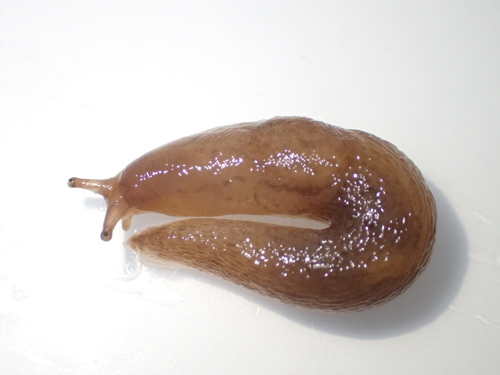
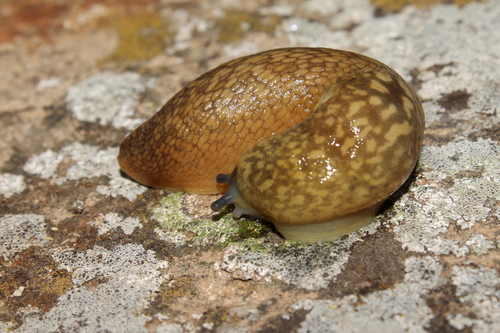
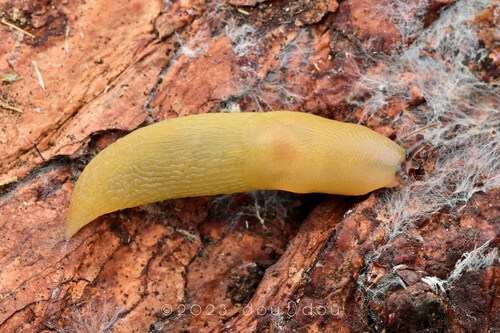
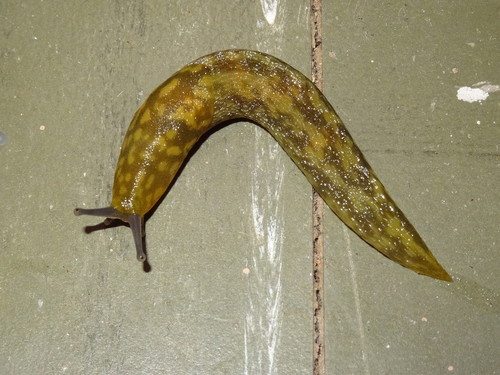
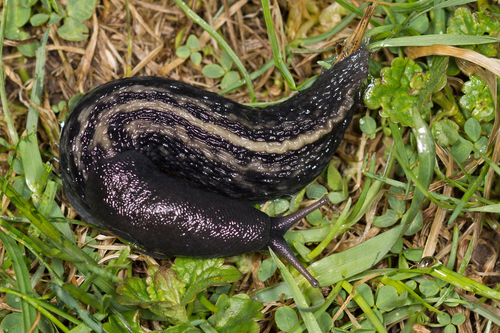
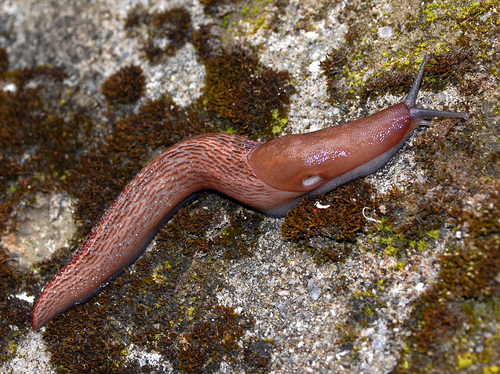
External appearance cannot reliably distinguish Ambigolimax valentianus from other members of its genus, such as A. parvipenis, with which it often occurs together. Like all other members of the Limacidae family, it has a pointed tail, and its pneumostome is located in the posterior half of the mantle. The most obvious characteristic of Ambigolimax slugs is often the presence of two parallel, sharply defined dark lines running along the mantle, sometimes with a thicker, less defined line between them. Two similar lines may appear further back along the back on either side of the midline, but all these lines can be faint or even completely absent in some individuals. Other individuals have additional dark dots and mottled darker pigment patches. Dorsal coloration is most commonly pinkish brown, but may sometimes be dull yellowish, grey, or any shade between these. Older individuals are usually yellower, with less prominent lines but more noticeable mottling. The slug’s mucus is colourless, transparent, and watery. Its maximum body length is around 8 cm. Confirmation of Ambigolimax valentianus identity relies on internal genitalia, which requires dissection to examine. Specifically, it has a large sausage-shaped penial appendage at the inner end of the penis; rarely, this appendage is wider towards its tip. Sometimes the appendage appears absent because it has inverted into the lumen of the penis. This can lead to confusion with A. parvipenis, but in Ambigolimax valentianus the penis (without the appendage) is approximately as long as the bursa copulatrix and its duct, while in A. parvipenis the penis is only about half that length. It has often been claimed that this species is native to Spain, but this claim is only based on the location of its first recording. The limited genetic variation observed in the Iberian Peninsula contradicts this hypothesis, and an origin in North Africa has been proposed instead. This species has been recorded widely across the globe, and its spread began more than 100 years ago. In the list of recorded locations below, oceanic islands are treated separately from the mainland countries they belong to. If the date of first collection is not provided in the cited source, the publication date of the first report is used instead. In Europe: Spain, recorded since 1821; Portugal, since 1891; Andorra, since 2000; France, since 1954; Great Britain, since 1936 in greenhouses, 1985–1986 outdoors; Island of Ireland, since 1932 in a botanic garden, 1981 outdoors; Belgium, since 1946 in greenhouses, 1973 outdoors; The Netherlands, since 1962; Germany, since 1948 in greenhouses; Denmark, since 1959; Sweden, since 1921 in greenhouses; Norway, since 1967 in greenhouses; Finland, since the 1960s in greenhouses; Latvia, since 2009 in a botanical garden; Lithuania, since 2010 in an indoor garden; Poland, since 1963; Switzerland, one isolated report from 1918; Italy, since 1979 outdoors; Malta, since 1986; Czech Republic, since 1960 in greenhouses; Slovakia, since 2020 outdoors; Austria, since 1980 in a botanical garden; Serbia, since 2010 in an indoor garden, 2025 outdoors; Greece, since 2007; Romania, since 1962 in greenhouses; European Russia, since 1980. In Africa: Algeria, since the 19th century; Morocco, since 1985; Libya, since 2018–2019; Egypt, since 2014–2018; South Africa, since 1961. In Asia: Turkey, since 2009; Israel, since 1979, the commonest garden slug by 2015; Uzbekistan, since 1980; Kazakhstan, since 1996; Iran, since 2004; Japan, since the late 1950s; China, since 1978; Singapore, since 2020 in cooled glasshouses; South Korea, since 2025. In Australasia: Australia, since 1911; New Zealand, since 1979; Papua New Guinea, since 2018. In the Americas: USA, since 1917 in greenhouses; already known from California, Colorado, Missouri, Arizona, Oklahoma, New York State, Michigan, Ohio, New Jersey, Massachusetts, Pennsylvania, Kansas, Maryland by 1961; Canada, since 1972 in greenhouses, Manitoba, 2000 outdoors, British Columbia; Dominican Republic, since 2012; Mexico, since 2017; Colombia, since 1963; Venezuela, since 1982; Brazil, since 1976; Argentina, since 1924; Chile, since 1893. In oceanic islands: Canary Islands (Spain), since 1950; Azores (Portugal), since 1957; Madeira (Portugal), since 1978; Tristan da Cunha (UK), since 1982; Gough Island (UK), since 2000; Hawaii (USA), since 1982; Juan Fernandez Islands (Chile), since 1908; Easter Island (Chile), since 1917; Ulleung Island (South Korea), since 2018, identified only as Ambigolimax sp. In captivity held at approximately 17 °C, eggs take around 3 weeks to hatch, and hatchlings take about 24 weeks to lay their first eggs. Over their lifetimes, these slugs lay on the order of 150 eggs, though one individual has been recorded laying 1510 eggs. Eggs are laid in clutches that vary widely in size, with 40 eggs being typical. Around half of slugs kept alone died within 15 months, but some individuals lived for more than two years. At 5 °C eggs take much longer to hatch, at 17 weeks; all eggs die when held at temperatures above 25 °C, though a small proportion survived brief 1-hour exposures to 31 °C. Most hatchlings survived exposure to 34 °C, but not 36 °C. Heat resistance varies adaptively across the year, as does cold resistance; in mid-winter, half of individuals can survive −8 °C, while for March hatchlings, the temperature at which half survive is −3 °C. In subtropical regions of Japan, A. valentianus follows an annual life cycle and reproduces during the colder part of the year. Egg laying takes place between November and May, but decreases during the coldest months. Sperm production begins slightly earlier in development than egg production. Most eggs hatch in April. In spring, two generations of the slug coexist with overlapping sizes, before the older generation dies off by June. In more temperate regions of Japan, the life cycle follows the same pattern but shifted two months earlier: slugs mature by August or September and die by May. In both populations, day length acts as the trigger for maturation. Slugs kept alone with no opportunity to mate still produced just as many fertile eggs as slugs kept in groups. However, population genetic data indicates that most free-living individuals outcross with other individuals. Ambigolimax valentianus feeds on green leaves and shoots, so it can act as a pest in greenhouses and even outdoors. It also feeds on animal matter and fallen leaves. Its activity and feeding begin before sunset, and peak in the early part of the night. This species rarely climbs trees, and during the day it is most commonly found under boards, rocks, and plant containers. This species is often first found in greenhouses after arriving in a new country, and from there spreads to gardens, other human-associated outdoor habitats, and even woodland, a process likely aided by modern global warming. Where it has been introduced, this species may become the dominant slug. A notable unusual consequence of its abundance on Gough Island is that it prevented the eradication of introduced house mice, by eating the poison bait dropped from helicopters.