About Ambigolimax parvipenis Hutchinson, Reise & Schlitt, 2022
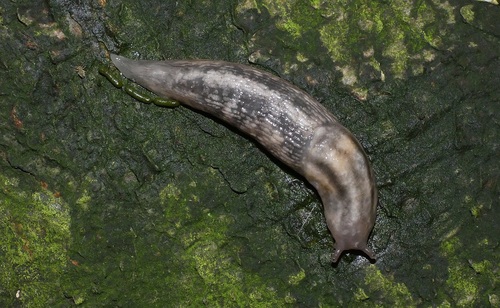
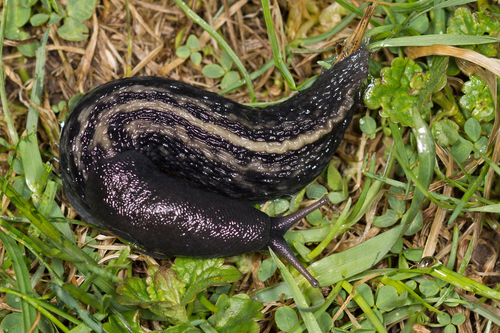
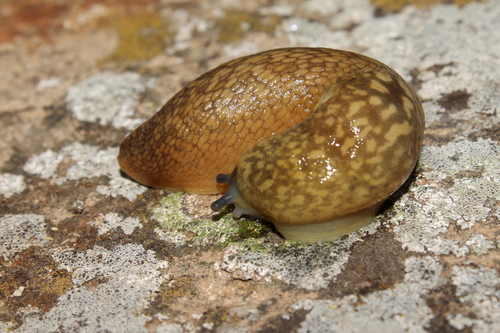
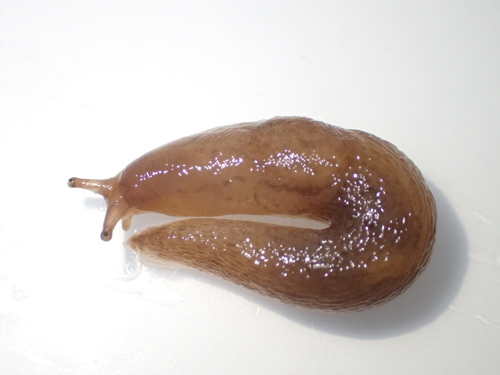
Ambigolimax parvipenis was formally described by Hutchinson, Reise & Schlitt in 2022. Adult crawling individuals of this species reach up to 80 mm in length, but many individuals reach maturity at a much smaller size. Like other members of the Limacidae family, these slugs have a slim body with a pointed tail, and their pneumostome is located in the posterior half of the mantle. Their mucus is transparent and colourless. Their body background colour ranges from yellowish-grey to various shades of brown, with paler flanks and a pale cream-coloured foot sole. Most individuals have at least faint traces of a pair of dark longitudinal lines on either side of the back midline, plus an additional pair of dark lines on either side of the mantle. Extra longitudinal dark lines and body spotting are often present. None of these external traits can reliably separate Ambigolimax parvipenis from Ambigolimax valentianus, which often shares habitat with A. parvipenis, or from other species in the genus Ambigolimax. This species can be definitively identified by its distinctive penis: it is roughly half the length of the bursa copulatrix and its duct, lacks a penial appendage, and only occasionally has a vestigial knob in the place of the appendage. Confirming the absence of a penial appendage requires cutting open the penis, because the penial appendage of A. valentianus can sometimes invert inside the penis and appear absent. The native distribution of Ambigolimax parvipenis is not confirmed, but researchers propose it is native to North Africa. The species was first recorded at multiple sites in Cornwall and Devon in southwest England between 1999 and 2000, and a 1987 record from Suffolk may also represent this species. Since these early records, it has spread widely across Britain and Ireland; by the end of 2021, it had been reported from 25 vice-counties in Britain and 3 vice-counties in Ireland. It is also known to occur in France, Hungary, Slovakia, Serbia, Greece, and Spain, including the Canary Islands and the Chafarinas Islands. It is widespread in California, where the earliest record dates to 2005, and there is a single known record from Arizona. Ambigolimax parvipenis is most commonly found in gardens and other similarly disturbed habitats. Older pre-2022 records that assigned individuals to Limax nyctelius, Lehmannia nyctelia or Ambigolimax nyctelius from South Africa, Australia, New Zealand, Edinburgh and Elba are now confirmed to actually refer to A. waterstoni, while older records of these names from the Carpathian Mountains south to Bulgaria refer to Lehmannia carpatica.