About Amazona xanthops (Spix, 1824)
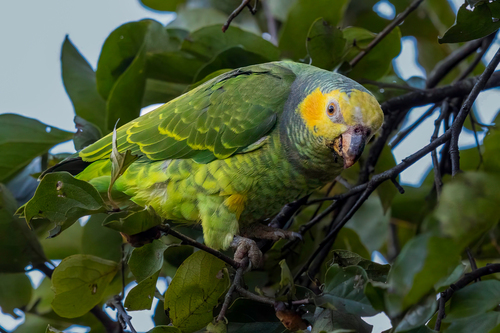
The yellow-faced parrot, scientifically named Amazona xanthops (Spix, 1824), measures around 27 cm (11 in) long, with a stocky body and short tail. It is mostly covered in green and yellow plumage. Adult yellow-faced parrots have yellow coloring on the crown, lores, cheeks, and auriculars. The remainder of the head, upperparts, and chest are green, with some yellowish-green scalloped patterning. The sides of the belly are often mottled with orange and yellow, and the belly itself is often yellow. There is substantial variation in how much yellow appears on the underparts, and some individuals have almost no yellow there. The wings are mostly green, and occasionally have a few yellow spots. The primary coverts have blue edging. The central feathers of the short tail are green, while the lateral tail feathers are more yellow-green and have orange-red bases. The bill is yellowish-horn colored with a dark culmen, the cere is pinkish, the iris is yellow, and the legs are light grey. This species has no sexual dimorphism, meaning males and females are identical in plumage and size. Immature birds have less yellow on the head than adults. Most of the yellow-faced parrot's range lies in central and eastern Brazil, where it occurs from Maranhão and Piauí south to São Paulo and Mato Grosso do Sul. It lives in cerrado on the Brazilian plateau, as well as drier Caatinga scrubland. There are only two recorded observations of this species from Beni in northeastern Bolivia. While it is sometimes reported to occur in Paraguay, there is no evidence to confirm its presence there. Within its known range, the yellow-faced parrot is considered semi-nomadic. Much of its habitat is currently being converted to agricultural land, and its populations are declining.