About Amazona vittata (Boddaert, 1783)
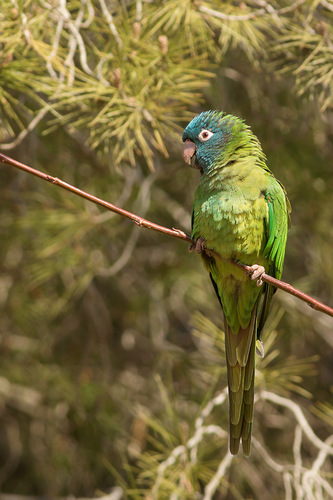
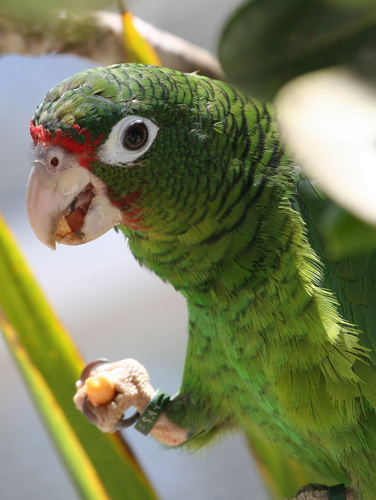
This species is the Puerto Rican amazon, with the scientific name Amazona vittata (Boddaert, 1783). It measures 28–30 cm (11.0–11.8 in) long and weighs 250–300 g (8.8–10.6 oz), with an average weight of 275 g (9.7 oz). While it is smaller than most Amazon parrots overall, it matches the size of other Amazona species native to the Greater Antilles. This species has no sexual dimorphism, and both males and females share the same plumage pattern. Both sexes have predominantly green feathers with blue edges. The primary flight feathers and main covert feathers of the wings are dark blue. Underside feather color differs by body region: the undersides of the wings, visible when the bird is in flight, are bright blue, while tail feathers have a yellow-green tone. The bird’s underparts are paler with a yellow tinge, it has a red forehead, and distinct white oval-shaped patches of feathers surrounding the eyes. It has a brown iris, a horn-colored bill, and yellow-tan legs. Outside of DNA testing, males and females can only be told apart by behavioral differences that occur during the breeding season. Immature Puerto Rican amazons have plumage that is nearly identical to that of adult birds. The exact original distribution of the Puerto Rican amazon before Spanish colonization is uncertain, due to a lack of contemporary historical records and the displacement and extermination of the indigenous Taíno people. However, evidence indicates the species was widespread and abundant across its range, and may have also inhabited other nearby islands including Antigua, Barbuda, and the Virgin Islands. Early population size estimates for the species vary widely: some experts estimate that there were once more than one million individuals, while others propose a smaller historical population of 100,000. During the first 150 years of Spanish rule, the human population of Puerto Rico remained low. In 1650, when the island’s total human population was only 880 people, the Puerto Rican amazon was still abundant across the entire archipelago. After 1650, human settlement and population growth grew exponentially, and by the 18th century, the Puerto Rican amazon population began to decline. German naturalist Heinrich Moritz Gaede recorded that the parrot’s population had noticeably decreased by 1836. Even with this decline, as late as 1864, British ornithologist Edward Cavendish Taylor noted that parrots were still common in the area near Puerto Rico’s capital, San Juan. Initially, human activity did not create a major threat to the Puerto Rican amazon. The Taíno people hunted the parrot, but this hunting had little impact on the overall species population. Over the past 200 years, however, multiple factors have caused a dramatic drop in population numbers: these include agricultural development, road construction, hydroelectric development, and the capture of young chicks to keep as pets. Especially in the second half of the 19th century, most of Puerto Rico’s virgin forests, the species’ historical native habitat, were cleared for agricultural use, primarily to grow sugar, cotton, corn, and rice. The Puerto Rican amazon quickly began to rely on these agricultural crops as its main food source, which led to it being classified as an agricultural pest. Local farmers attempted to repel or hunt the birds wherever they occurred. As agricultural land expanded, more of the parrot’s natural habitat was lost, and its population continued to shrink. Historically, the species lived in mature or old-growth forests across all elevations of Puerto Rico, and also used holes, cliffs, and other varied habitats at lower elevations. It was found at medium elevations in Guajataca State Forest until 1910, in Rio Abajo State Forest until the 1920s, and at high elevations in Carite State Forest until the 1930s. Accounts from the early 1900s record that parrots traveled away from Luquillo forest and the Sierra de Cayey toward the main island’s coast to find food. The species was extirpated from Culebra by the early 20th century. The karst region in northwestern Puerto Rico was identified as a refuge for the remaining population. In particular, a region called Valle de las Cotorras (Valley of the Parrots), located between the towns of San Sebastián and Morovis, supported a large parrot population. Eventually, the species’ remaining natural habitat was reduced to the Cordillera Central mountain range. By 1960, Puerto Rican amazons were only found in primary forest in the Luquillo Mountains, within El Yunque National Forest. Currently, the species occurs at elevations between 396 and 823 m (1,299 and 2,700 ft). Since the species requires mature forests with trees that have open cavities for nesting and reproduction, it does not live in dwarf forests or secondary forests. By the 1950s, there were only 200 Puerto Rican amazons left in the wild. In 1975, the wild population reached an all-time low of just 13 individuals. Populations began to recover after this point, and by August 1989, there was an estimated minimum of 47 wild individuals. On September 18, 1989, Hurricane Hugo struck the northeast coast of Puerto Rico, causing heavy mortality in the remaining wild parrot population. After the hurricane, the wild population was estimated at just 23 individuals. In 2004, the wild population numbered between 30 and 35 individuals, with a long-term population trend that appeared stable despite small fluctuations. The species’ current total range is 16 km2 (6.2 sq mi), which equals just 0.2% of its original historical range. In the aftermath of Hurricane María, it was estimated that only 3 out of 50 wild parrots survived, representing a 90% loss to the wild population. Species recovery programs remain ongoing, and as of 2021 the total combined population of wild and captive Puerto Rican amazons is around 500 individuals.