About Amazona viridigenalis (Cassin, 1853)
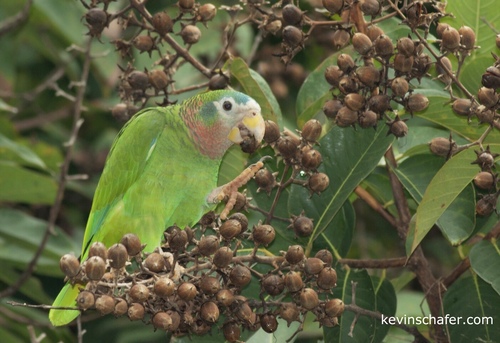
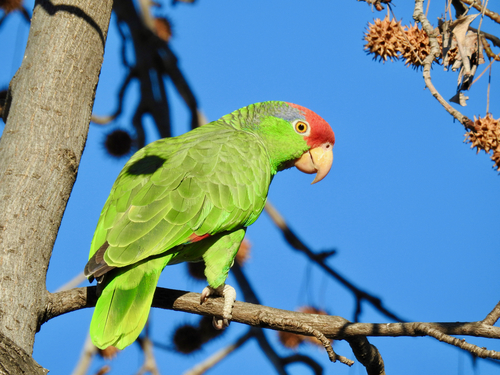
This species, Amazona viridigenalis, also commonly called the red-crowned amazon, has an overall green plumage. Its most prominent features are a bright red forehead and crown, a dark blue streak running behind the eyes, and light green cheeks. Many individuals have patches of red and blue on the undersides of their wings, and their tails have light yellow tips. They have a distinct white eye-ring that makes their eyes stand out. Their iris color can vary from bright yellow to deep red; juvenile birds have gray irises that do not change to the adult coloration until they reach maturity. Most individuals have horn-colored beaks and ceres, though these sometimes have black markings. Their legs are beige or gray. They measure approximately 11–13 inches (28–33 cm) in total length from the tip of the beak to the end of the tail feathers, with a wingspan of 15–16 inches (38–41 cm), and an average weight of 270 grams (9.5 oz).
Most amazon parrots, including this species, are not sexually dimorphic; the only exceptions are the white-fronted amazon (Amazona albifrons), yellow-lored amazon (Amazona xantholora), and blue-fronted amazon (Amazona aestiva). This means genetic testing is the only reliable way to determine the sex of red-crowned amazons.
The species' natural native range covers the lowlands of northeastern Mexico, and may extend to the southern tip of Texas. Red-crowned amazons are non-migratory residents within their native range, but they may travel outside their breeding range to track available food sources. Feral populations have established breeding populations in urban areas of southern California, southern Florida, and the Hawaiian island of Oahu, as well as in the town of Salinas, Puerto Rico. On June 4, 2019, the US Fish & Wildlife Service (USFWS) Corpus Christi Ecological Services Field Office publicly stated that USFWS considers the red-crowned parrot native to Texas's Rio Grande Valley. However, since parrots were not included in the Migratory Bird Treaty Act of 1918, individuals in the Texas portion of the species' range are not eligible for USFWS protection, and protection depends only on existing state and local laws. In 2019, USFWS estimated that around 700 wild red-crowned parrots live in Texas's Rio Grande Valley, and historical records document parrots in South Texas as early as 1885. Wild populations in the United States now have numbers comparable to native populations in Mexico, due to the species' successful adaptation to urban habitats. Despite this, the IUCN and other sources consider the species non-native to all areas of the United States, including southern Texas. NatureServe lists the species as "Imperiled" in Texas.
Red-crowned amazons reach sexual maturity at approximately five years of age. The average clutch size is four eggs, which are incubated by the female over roughly 28 days. Chicks fledge at nine weeks old. In the wild, these parrots mate for life. They seek out tree cavities to nest near other members of their flock, forming collective breeding groups called colonies. They return to the same nesting cavity each year to raise chicks, unless the cavity has been poached, or the pair had unsuccessful reproductive attempts there for other reasons.