About Amazona vinacea (Kuhl, 1820)
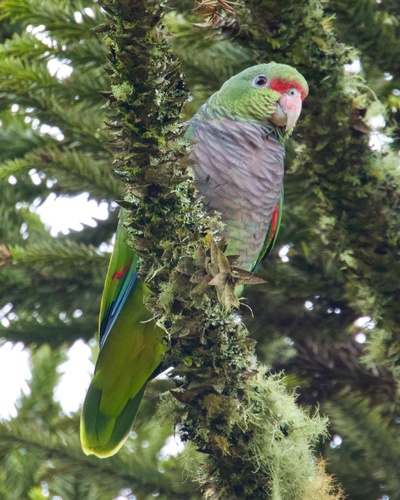
The vinaceous-breasted amazon, scientific name Amazona vinacea (Kuhl, 1820), measures 30 to 36 cm (12 to 14 inches) in length. Its plumage is mostly green, with red markings on the lores and forehead, a turquoise nape, and a lilac-colored breast. Red markings also appear on its carpal edge, speculum, and the base of its outer tail feathers. The primary flight feathers have blue to black tips. Its bill has a rosy pink to red base and a horn-colored tip. Its iris ranges from red-orange to chestnut, and is surrounded by pale gray skin; its legs and feet are gray. The species has a disjunct distribution. Today it is found in scattered locations generally ranging from São Paulo state in Brazil southward into Rio Grande do Sul, eastern Paraguay, and the far northeastern Misiones Province of Argentina. Historically, it occurred as far north as Bahia, Brazil, and as far south as Corrientes Province, Argentina. It lives in a wide variety of landscapes within the Atlantic Forest biome, but tends to concentrate in mixed forest with large populations of paraná pine (Araucaria angustifolia). It can also be found in small forest patches, young secondary forest, pastures and grasslands with scattered trees, plantations of introduced pine and Eucalyptus, and in areas surrounding towns.